
Kimi LeetCode 3378. 统计最小公倍数图中的连通块数目 Rust实现
以下是 LeetCode 3378. 统计最小公倍数图中的连通块数目 的 Rust 实现(已包含 LeetCode 提交格式):
解题思路
本题核心思路是 并查集 + 倍数枚举:
1. 关键观察:如果 `a` 能整除 `b`(即 `b` 是 `a` 的倍数)且 `b <= threshold`,则 `lcm(a, b) = b <= threshold`,所以 `a` 和 `b` 之间必有边。
2. 大于 threshold 的数:`lcm(a, b) >= max(a, b)`,所以若 `nums[i] > threshold`,它与任何数的 lcm 都大于 threshold,是孤立节点。
3. 枚举策略:对于每个 `num <= threshold`,枚举其所有倍数 `j = num, 2*num, 3*num, ... <= threshold`,将这些数与 `num` 用并查集合并。这样所有有公共因子的数最终会被合并到同一个连通块。
4. 统计答案:大于 threshold 的数各自独立;小于等于 threshold 的数通过并查集找根节点,统计不同根的数量。
Rust 代码(LeetCode 提交格式)
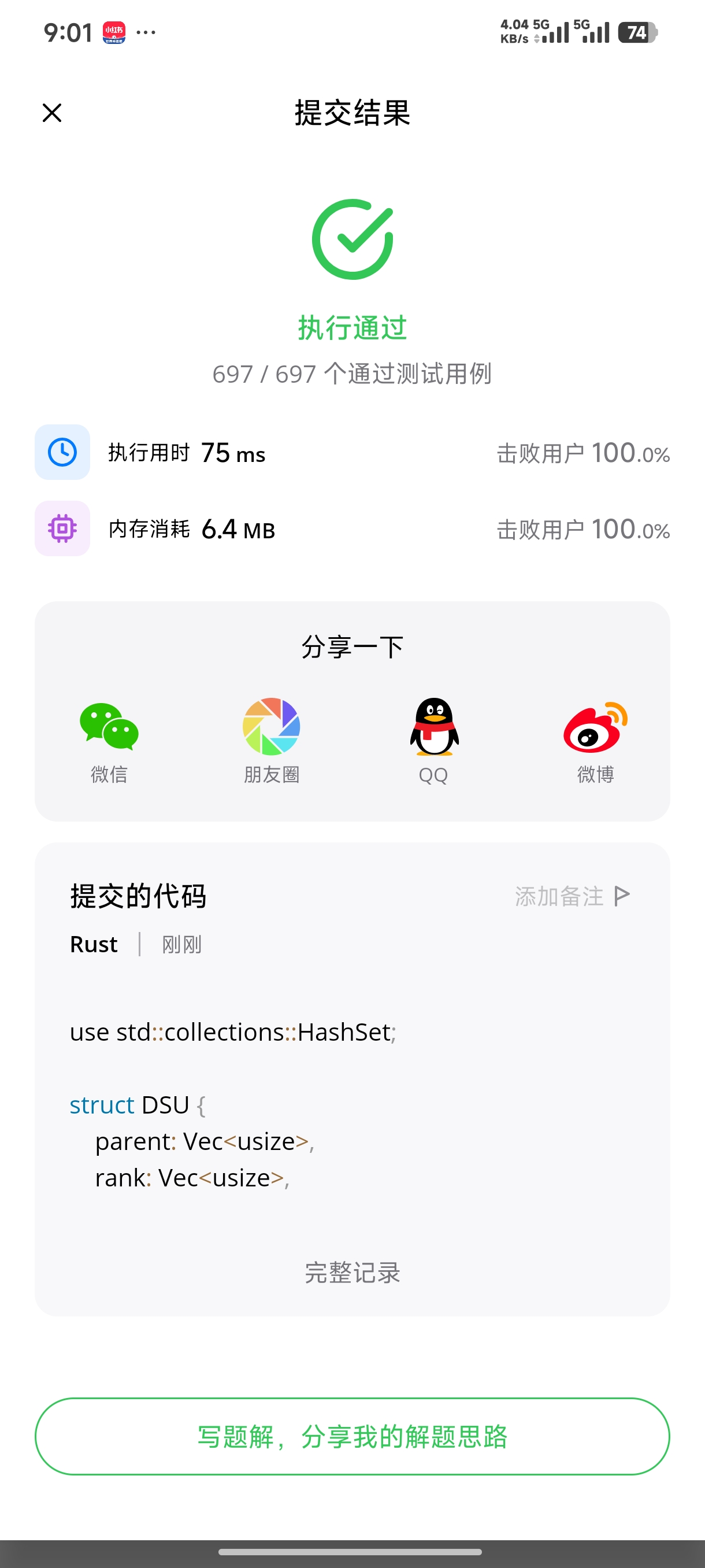
```rust
use std::collections::HashSet;
struct DSU {
parent: Vec<usize>,
rank: Vec<usize>,
}
impl DSU {
fn new(n: usize) -> Self {
let mut parent = vec![0; n + 1];
let mut rank = vec![0; n + 1];
for i in 0..=n {
parent[i] = i;
}
DSU { parent, rank }
}
/// 查找根节点,带路径压缩
fn find(&mut self, x: usize) -> usize {
if self.parent[x] != x {
self.parent[x] = self.find(self.parent[x]);
}
self.parent[x]
}
/// 合并两个集合,按秩合并
fn union(&mut self, u: usize, v: usize) {
let mut u_root = self.find(u);
let mut v_root = self.find(v);
if u_root == v_root {
return;
}
// 按秩合并:将秩较小的树合并到秩较大的树下
if self.rank[u_root] < self.rank[v_root] {
std::mem::swap(&mut u_root, &mut v_root);
}
self.parent[v_root] = u_root;
if self.rank[u_root] == self.rank[v_root] {
self.rank[u_root] += 1;
}
}
}
impl Solution {
pub fn count_components(nums: Vec<i32>, threshold: i32) -> i32 {
let threshold = threshold as usize;
let mut dsu = DSU::new(threshold);
// 对于每个 num <= threshold,将其与所有倍数用并查集合并
for &num in &nums {
let num = num as usize;
if num > threshold {
continue; // 大于 threshold 的数不参与并查集
}
// 枚举 num 的所有倍数:num, 2*num, 3*num, ... <= threshold
let mut j = num;
while j <= threshold {
dsu.union(num, j);
j += num;
}
}
// 统计连通块数量
let mut unique_parents = HashSet::new();
for &num in &nums {
let num = num as usize;
if num > threshold {
// 大于 threshold 的数各自独立成一个连通块
unique_parents.insert(num);
} else {
unique_parents.insert(dsu.find(num));
}
}
unique_parents.len() as i32
}
}
```
复杂度分析
- 时间复杂度:O(threshold × log(threshold))。对于每个数 `num`,枚举其倍数的时间为 `threshold/num`,总和约为 `threshold × (1 + 1/2 + 1/3 + ...)` ≈ `threshold × log(threshold)`。并查集操作近似 O(α(n))。
- 空间复杂度:O(threshold),用于并查集数组和 HashSet。
示例验证
- 示例1:`nums = [2,4,8,3,9], threshold = 5`
- 大于 5 的数:8, 9 → 各自独立(2个连通块)
- 2 的倍数:2, 4 → 合并 2 和 4
- 3 的倍数:3(无其他倍数 ≤5)
- 最终连通块:{2,4}, {3}, {8}, {9} → 4个
- 示例2:`nums = [2,4,8,3,9,12], threshold = 10`
- 大于 10 的数:12 → 1个连通块
- 2 的倍数:2, 4, 6, 8, 10 → 合并 2,4,8
- 3 的倍数:3, 6, 9 → 合并 3,9
- 通过 6(2×3),2的连通块和3的连通块连通
- 最终连通块:{2,3,4,8,9}, {12} → 2个
下载文件:[leetcode_3378.rs](sandbox:///mnt/agents/output/leetcode_3378.rs)
更多推荐
 6
6 0
0- 0


 已为社区贡献102条内容

所有评论(0)