
【Python时序预测系列】建立Bi-LSTM模型实现多变量多步时序预测(案例+源码)
·
这是我的第465篇原创文章。
一、引言
下面通过一个具体的案例,建立Bi-LSTM(双向LSTM)模型进行多变量输入单变量输出多步时间序列预测,包括模型构建、训练、预测等等。
二、实现过程
2.1 原始数据集加载
核心代码:
df = pd.read_csv(
    "data.csv",
    parse_dates=["Date"],
    index_col=[0],
)
df = pd.DataFrame(df)
var_num = len(df.columns)
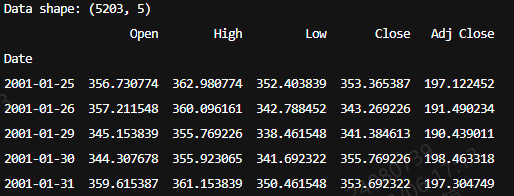
print(f"Data shape: {df.shape}")
print(df.head())
结果:
2.2 数据集划分
核心代码:
test_split = round(len(df) * 0.20)
df_for_training = df[:-test_split]
df_for_testing = df[-test_split:]
print(
    f"Training samples: {len(df_for_training)}, Testing samples: {len(df_for_testing)}"
)
结果:

2.3 数据归一化
核心代码:
scaler = MinMaxScaler(feature_range=(0, 1))
df_for_training_scaled = scaler.fit_transform(df_for_training)
df_for_testing_scaled = scaler.transform(df_for_testing)
2.4 构造时序预测数据集
核心代码:
train_dataset = TimeSeriesDataset(df_for_training_scaled, seq_len=seq_len, pred_len=pred_len)
test_dataset = TimeSeriesDataset(df_for_testing_scaled, seq_len=seq_len, pred_len=pred_len)
train_loader = DataLoader(train_dataset, batch_size=batch_size, shuffle=True)
test_loader = DataLoader(test_dataset, batch_size=batch_size, shuffle=False)
2.5 建立Bi-LSTM模型
核心代码:
class BiLSTM(nn.Module):
    def __init__(
        self, input_dim=5, lstm_hidden=128, lstm_layers=2, pred_len=5, dropout=0.2
    ):
        super().__init__()
        self.lstm = nn.LSTM(
            input_size=input_dim,
            hidden_size=lstm_hidden,
            num_layers=lstm_layers,
            batch_first=True,
            dropout=dropout if lstm_layers > 1 else 0,
            bidirectional=True,
        )
        self.fc = nn.Sequential(
            nn.Linear(lstm_hidden * 2, lstm_hidden),
            nn.ReLU(),
            nn.Dropout(dropout),
            nn.Linear(lstm_hidden, pred_len),
        )
        self.pred_len = pred_len
    def forward(self, x):
        lstm_out, (hidden, cell) = self.lstm(x)
        last_hidden = lstm_out[:, -1, :]
        out = self.fc(last_hidden)
        return out.unsqueeze(-1)
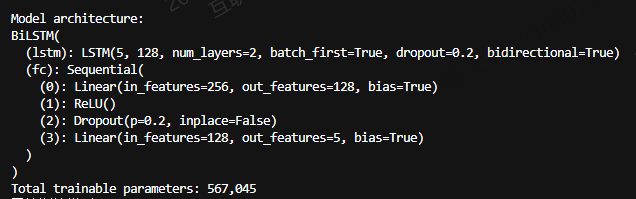
模型结构:
2.6 模型训练
核心代码:
def train_model(model, dataloader, num_epochs=50, learning_rate=1e-3, device="cpu"):
    optimizer = torch.optim.Adam(model.parameters(), lr=learning_rate)
    criterion = nn.MSELoss()
    model.train()
    loss_history = []
    for epoch in range(num_epochs):
        epoch_losses = []
        for batch_data, batch_targets in dataloader:
            batch_data = batch_data.to(device)
            batch_targets = batch_targets.to(device)
            optimizer.zero_grad()
            outputs = model(batch_data)
            loss = criterion(outputs, batch_targets)
            loss.backward()
            optimizer.step()
            epoch_losses.append(loss.item())
        avg_loss = np.mean(epoch_losses)
        loss_history.append(avg_loss)
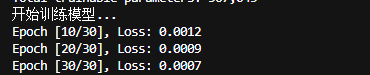
        if (epoch + 1) % 10 == 0:
            print(f"Epoch [{epoch + 1}/{num_epochs}], Loss: {avg_loss:.4f}")
    return loss_history
结果:
2.7 模型评测
核心代码:
def evaluate_model(model, dataloader, device="cpu"):
    model.eval()
    preds = []
    trues = []
    with torch.no_grad():
        for batch_data, batch_targets in dataloader:
            batch_data = batch_data.to(device)
            outputs = model(batch_data)
            preds.append(outputs.cpu().numpy())
            trues.append(batch_targets.cpu().numpy())
    # print(preds.shape)
    # print(trues.shape)
    preds = np.concatenate(preds, axis=0).squeeze()
    trues = np.concatenate(trues, axis=0).squeeze()
    print(preds.shape)
    print(trues.shape)
    return preds, trues
2.8 可视化分析
图 1:训练损失曲线
plt.plot(loss_history, marker='o', color='dodgerblue', linestyle='-', linewidth=2)
plt.title("Training Loss Curve")
plt.xlabel("Epoch")
plt.ylabel("MSE Loss")
plt.tight_layout()
plt.savefig('output_image1.png', dpi=300, format='png')
plt.show()
结果:
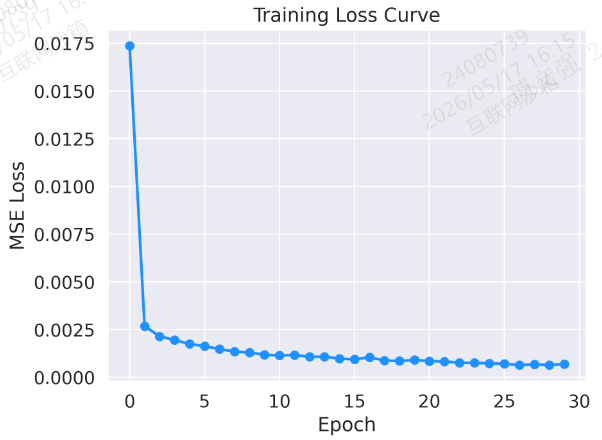
图 2:真实值与预测值对比曲线
plt.plot(trues, label="True Values", color='limegreen')
plt.plot(preds, label="Predicted Values", color='crimson')
plt.title("True vs. Predicted Values")
plt.xlabel("Sample Index")
plt.ylabel("Trend Value")
plt.legend()
plt.tight_layout()
plt.savefig('output_image2.png', dpi=300, format='png')
plt.show()
结果:
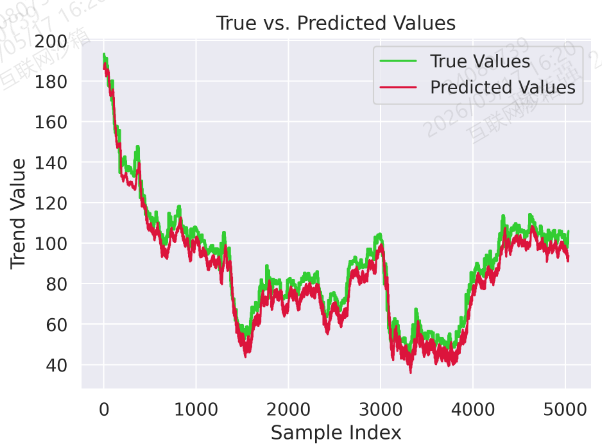
图4:残差分布与 KDE
resid = (preds - trues).reshape(-1)
sns.histplot(
    resid, bins=40, stat="density", color=vivid_colors[3], kde=True, alpha=0.7
)
plt.axvline(
    np.mean(resid),
    color=vivid_colors[0],
    linestyle="--",
    linewidth=2,
    label=f"Mean={np.mean(resid):.3f}",
)
plt.title("residual distribution and KDE")
plt.xlabel("residual")
plt.ylabel("density")
plt.legend()
plt.tight_layout()
plt.savefig("output_image4.png", dpi=300, format="png")
plt.show()
结果:
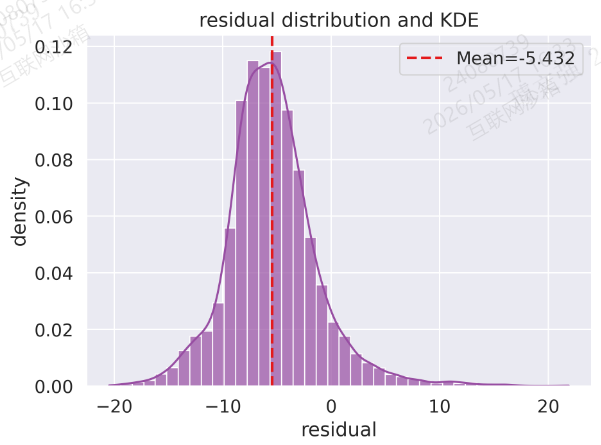
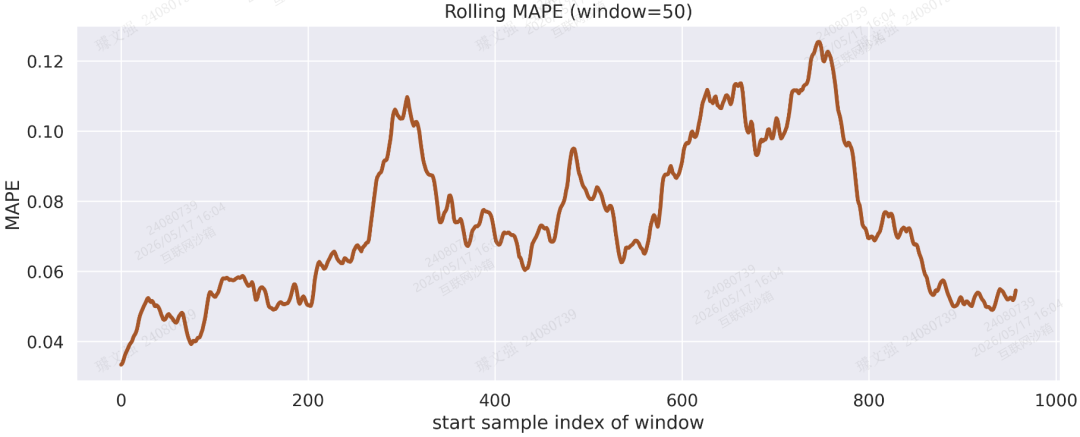
图5:Rolling MAPE(窗口=50 个样本)
win = 50
mape_series = np.abs((preds - trues) / (np.abs(trues) + 1e-8)).mean(axis=1)
rolling = np.array(
    [mape_series[i : i + win].mean() for i in range(0, len(mape_series) - win + 1)]
)
plt.figure(figsize=(12, 5))
plt.plot(rolling, linewidth=3, color=vivid_colors[6])
plt.title(f"Rolling MAPE (window={win})")
plt.xlabel("start sample index of window")
plt.ylabel("MAPE")
plt.tight_layout()
plt.savefig("output_image5.png", dpi=300, format="png")
plt.show()
结果:
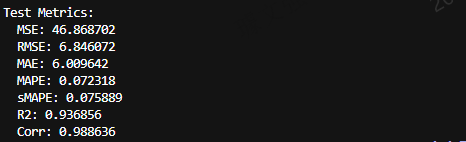
2.9 指标计算
核心代码:
def evaluate_metrics(y_true, y_pred):
    y_true = y_true.reshape(-1)
    y_pred = y_pred.reshape(-1)
    eps = 1e-8
    mse = np.mean((y_true - y_pred) ** 2)
    rmse = np.sqrt(mse + eps)
    mae = np.mean(np.abs(y_true - y_pred))
    mape = np.mean(np.abs((y_true - y_pred) / (np.abs(y_true) + eps)))
    smape = np.mean(
        2 * np.abs(y_true - y_pred) / (np.abs(y_true) + np.abs(y_pred) + eps)
    )
    # R2
    ss_res = np.sum((y_true - y_pred) ** 2)
    ss_tot = np.sum((y_true - np.mean(y_true)) ** 2) + eps
    r2 = 1 - ss_res / ss_tot
    # Pearson
    corr = np.corrcoef(y_true, y_pred)[0, 1]
    return dict(MSE=mse, RMSE=rmse, MAE=mae, MAPE=mape, sMAPE=smape, R2=r2, Corr=corr)
结果:
作者简介:
读研期间发表6篇SCI数据挖掘相关论文,现在某研究院从事数据算法相关科研工作,结合自身科研实践经历不定期分享关于Python、机器学习、深度学习、人工智能系列基础知识与应用案例。致力于只做原创,以最简单的方式理解和学习,关注我一起交流成长。需要数据集和源码的小伙伴可以关注底部公众号添加作者微信。
更多推荐
 7
7 0
0- 0


 已为社区贡献5条内容

所有评论(0)