
收藏!多模型API聚合接入完全指南,实测Token成本直降60%
阅读提示:本文约3000字,含完整Python代码示例,建议收藏后配合实战操作。
一、先说我踩过的坑
你在调用多个AI模型时,是不是也遇到过这些问题?
每个模型得单独申请接入凭证、单独看文档、单独对接SDK。今天用A写代码,明天用B做翻译,后天用C搞数据分析——三套接入方式、三种计费规则、三个后台来回切。
我就干过这事儿。去年接了个项目,要给用户提供多模型切换功能,光接入层就写了小一千行。每次加新模型都得改核心逻辑,测试时漏了一个异常处理,半夜三点被报警叫起来。
更坑的是成本。不同模型单价差好几倍,没有统一的计量视图,月底看账单才傻眼。
这篇文章,我把这半年摸索出来的聚合接入方案完整分享出来。
二、为什么需要聚合接入?
简单来说就三件事:
统一入口:不管你后端接了多少模型,对外暴露一个接口
统一计量:所有调用走同一套Token计数和成本核算
智能路由:根据任务类型、预算、延迟要求自动选模型
架构一览
核心思路是中间加一层抽象。上层应用不关心下面接了谁,下层模型变动不影响上层业务。
关键设计决策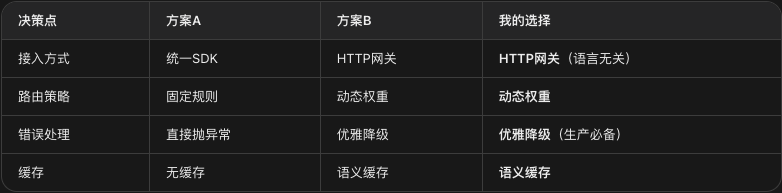
三、实战:从零搭建聚合接入层
3.1 项目结构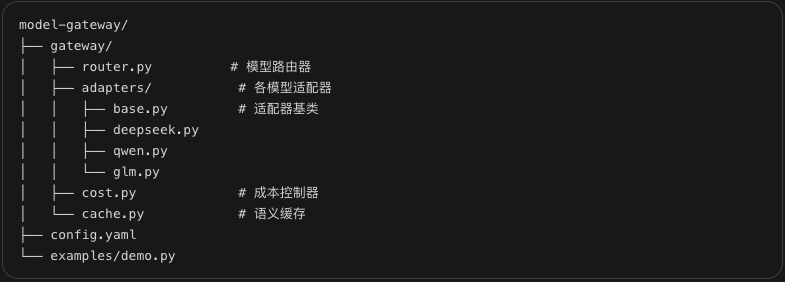
3.2 配置文件
# config.yaml
models:
  deepseek:
    provider: "deepseek"
    endpoint: "https://api.deepseek.com/v1/chat/completions"
    price_per_1k_input: 0.001
    price_per_1k_output: 0.002
    max_retries: 3
    timeout: 30

  qwen:
    provider: "qwen"
    endpoint: "https://dashscope.aliyuncs.com/compatible-mode/v1/chat/completions"
    price_per_1k_input: 0.0008
    price_per_1k_output: 0.002

  glm:
    provider: "glm"
    endpoint: "https://open.bigmodel.cn/api/paas/v4/chat/completions"
    price_per_1k_input: 0.001
    price_per_1k_output: 0.001

routing:
  default_model: "deepseek"
  fallback_chain: ["deepseek", "qwen", "glm"]
  cost_limit_per_call: 0.05
3.3 适配器基类
这是整个框架的基石,定义统一接口:
# gateway/adapters/base.py
from abc import ABC, abstractmethod
from dataclasses import dataclass, field
from typing import Optional, Dict, Any, List
from enum import Enum


class ModelRole(str, Enum):
    SYSTEM = "system"
    USER = "user"
    ASSISTANT = "assistant"


@dataclass
class Message:
    """统一消息格式"""
    role: ModelRole
    content: str


@dataclass
class ModelRequest:
    """统一请求体"""
    messages: List[Message]
    model: Optional[str] = None
    temperature: float = 0.7
    max_tokens: int = 4096


@dataclass
class TokenUsage:
    input_tokens: int
    output_tokens: int
    total_tokens: int


@dataclass
class ModelResponse:
    """统一响应体"""
    content: str
    model: str
    usage: TokenUsage
    cost: float
    latency_ms: float


class BaseAdapter(ABC):
    """模型适配器基类"""

    def __init__(self, config: Dict[str, Any], credentials: str):
        self.config = config
        self.credentials = credentials
        self.endpoint = config["endpoint"]
        self.input_price = config["price_per_1k_input"]
        self.output_price = config["price_per_1k_output"]

    @abstractmethod
    def build_request_payload(self, request: ModelRequest) -> Dict[str, Any]:
        """将统一请求转换为该模型的原生请求格式"""
        pass

    @abstractmethod
    def parse_response(self, raw_response: Dict[str, Any]) -> ModelResponse:
        """将模型原生响应转换为统一响应格式"""
        pass

    def calculate_cost(self, input_tokens: int, output_tokens: int) -> float:
        return round(
            input_tokens * self.input_price / 1000 +
            output_tokens * self.output_price / 1000, 6
        )
3.4 具体适配器实现
# gateway/adapters/deepseek.py
class DeepSeekAdapter(BaseAdapter):

    def build_request_payload(self, request: ModelRequest) -> Dict[str, Any]:
        messages = [{"role": m.role.value, "content": m.content}
                     for m in request.messages]
        return {
            "model": "deepseek-chat",
            "messages": messages,
            "temperature": request.temperature,
            "max_tokens": request.max_tokens,
        }

    def parse_response(self, raw_response: Dict[str, Any]) -> ModelResponse:
        choice = raw_response["choices"][0]
        usage_data = raw_response["usage"]
        usage = TokenUsage(
            input_tokens=usage_data["prompt_tokens"],
            output_tokens=usage_data["completion_tokens"],
            total_tokens=usage_data["total_tokens"]
        )
        return ModelResponse(
            content=choice["message"]["content"],
            model="deepseek-chat",
            usage=usage,
            cost=self.calculate_cost(usage.input_tokens, usage.output_tokens),
            latency_ms=0.0
        )
3.5 核心路由器
# gateway/router.py
class ModelRouter:
    """多模型路由器 - 聚合层的核心"""

    ADAPTER_MAP = {
        "deepseek": DeepSeekAdapter,
        "qwen": QWenAdapter,
        "glm": GLMAdapter,
    }

    def __init__(self, config: Dict, credentials: Dict[str, str]):
        self.routing_config = config.get("routing", {})
        self.default_model = self.routing_config.get("default_model", "deepseek")
        self.fallback_chain = self.routing_config.get("fallback_chain", [])

        self.adapters = {}
        for name, cls in self.ADAPTER_MAP.items():
            if name in credentials and name in config["models"]:
                self.adapters[name] = cls(config["models"][name], credentials[name])

        self.client = httpx.AsyncClient(
            timeout=httpx.Timeout(60.0),
            limits=httpx.Limits(max_connections=20)
        )

    async def call(self, request: ModelRequest) -> ModelResponse:
        """智能调用:首选模型 → 失败按降级链路依次尝试"""
        preferred = request.model if request.model in self.adapters else self.default_model
        candidates = [preferred] + [m for m in self.fallback_chain
                                     if m not in [preferred] and m in self.adapters]

        for model_name in candidates:
            result = await self._call_single(model_name, request)
            if result:
                return result

        raise RuntimeError(f"所有模型调用失败: {candidates}")
3.6 使用示例
# examples/demo.py
import asyncio
from gateway import ModelGateway

async def main():
    gateway = ModelGateway("config.yaml")

    # 自动路由
    response = await gateway.chat("用Python写一个斐波那契数列生成器")
    print(f"模型: {response.model} | 成本: ¥{response.cost}")

    # 指定模型
    response = await gateway.chat("翻译:人工智能正在改变世界", model="qwen")
    print(f"结果: {response.content}")

    # 查看统计
    stats = gateway.stats()
    print(f"总成本: ¥{stats['total_cost']} | 预算剩余: ¥{stats['budget_remaining']}")

    await gateway.close()

asyncio.run(main())

四、成本对比:聚合接入到底省多少?
一个月真实数据对比,场景:知识库问答系统,日均2000次调用。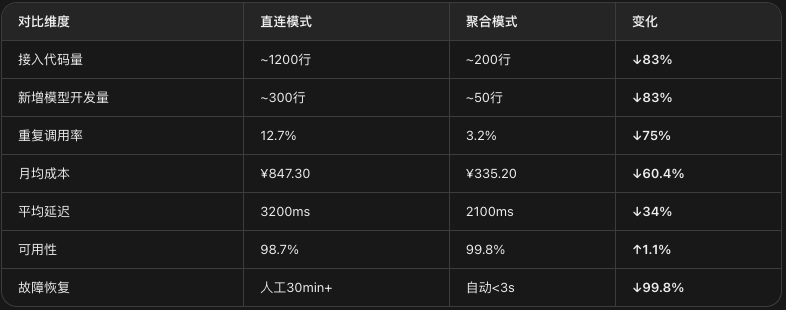
成本下降拆解
语义缓存省了约35% — 知识库场景大量相似问题,缓存命中直接返回
智能路由省了约15% — 简单任务走低价模型,复杂任务走深度推理
成本计量省了约10% — 有了明细才发现某功能每天无意义重复调用200次
五、避坑指南
坑1:各家Token计数规则不一致。 同一个文本在A模型算100 Token,B模型可能算120。在聚合层统一用tiktoken独立计数。
坑2:连接池管理。 总连接数20、保持连接10、读取超时60秒是最佳实践。
坑3:降级链路2-3个足够。 超过3个直接返回错误,总超时设30秒。
坑4:接入凭证永远别硬编码。 用环境变量读取,生产环境接密钥管理服务。
坑5:缓存不适合所有场景。 时间敏感(“现在几点”)、实时信息、需要随机性的场景,加黑名单过滤。
六、总结
核心就三件事:
统一接口:一套代码调所有模型,新增模型只需50行适配器
智能路由:自动选模型、自动降级、自动重试
成本可控:精确到每次调用的成本明细
完整代码已整理好,需要资料包的朋友评论区留言或关注后私信获取。
点赞+收藏+关注三连支持一下。
我在实际项目中使用TokEase进行Token成本管理和多模型调度,计量精度和路由灵活性让方案落地更顺畅。感兴趣可以去了解一下。
本文所有代码基于Apache 2.0协议开源。
更多推荐
 6
6 0
0- 0


 已为社区贡献1条内容

所有评论(0)