
I have a dedicated server build of a in-development realtime multiplayer game that I'd like to run on a Kubernetes cluster. The game uses WebRTC RTCDataChannels for network communication as it targets browsers. When running the game server on a Kubernetes node players can connect directly to it if I configure my Pods with hostNetwork: true. In the absence of hostNetwork: true players can still connect directly but only if they're behind well behaving NATs, if they're not then the only option for a successful connection is to introduce a TURN server to relay the traffic.
The reason for this appears to be that the game server runs on a Kubernetes node behind what is essentially a symmetric NAT i.e. the NATs mapping behaviour is address and port dependent. I've confirmed this by firing two STUN messages at different STUN servers from the same UDP socket within the container - the binding responses have the same public IP but different ports.
This NAT behaviour impacts WebRTC by reducing the success rate of players connecting directly to the game server in the absence of using a TURN server to relay traffic. Now I'd very much like to avoid relaying traffic through a TURN server where possible due to the added latency - it's not overly desirable for a realtime multiplayer game.
I'd have liked to just set hostNetwork: true and be done with it but I'm considering using Agones which doesn't support it (as it takes away the ability to securely do sidecars).
So I'm wondering if I have any other options (ideally without introducing yet another server to relay traffic through) to tweak this NAT behaviour as I don't believe it's feasible to try to forward the full range of random UDP ports that WebRTC is going to try to use for communication?
Update: Reading through the TURN RFC and I'm now thinking the below diagrammed setup may be possible using a TURN server running in the same container as the dedicated game server (thus latency introduction should be minimal).
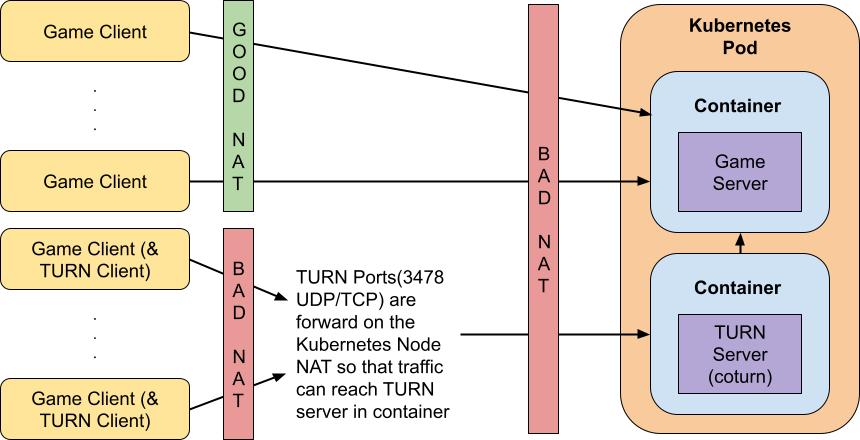
The game clients will act as the TURN Clients i.e. create the allocation on the TURN server, etc.
The Game Server will act as the peer with which the clients want to communicate. The Game Server itself wouldn't need to be a TURN client and if my understanding is correct not even need to know that the TURN server is a TURN server.


 已为社区贡献20439条内容

所有评论(0)