
React状态管理新范式:从Zustand到原子化状态的架构抉择与实践
React状态管理新范式:从Zustand到原子化状态的架构抉择与实践
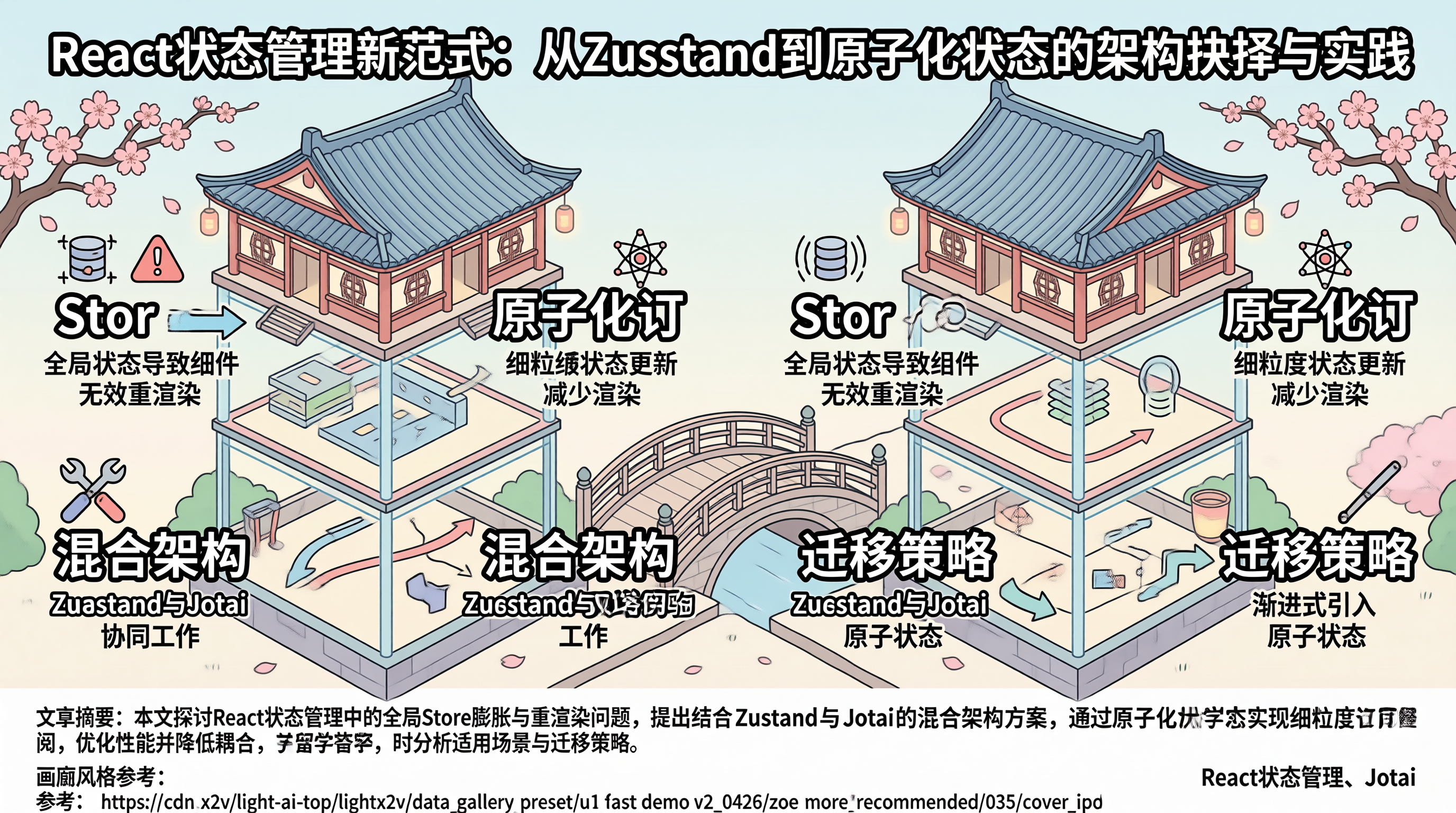
一、状态管理的永恒困境:全局Store的膨胀与组件重渲染陷阱
React应用的状态管理始终是一个令人头疼的工程问题。当项目从几十个组件增长到数百个组件时,全局Store(无论是Redux还是Zustand)不可避免地膨胀为一个巨型对象树。一个常见的性能陷阱是:组件A只依赖Store中的 user.name,但当 user.avatar 更新时,组件A也会触发重渲染,因为它们订阅的是同一个 user 切片。
这个问题的根源在于,传统的全局Store采用"集中式订阅"模型——组件通过Selector从Store树中提取所需数据,但Selector的粒度往往不够细。即使使用 shallow equal 比较,当Selector返回的是对象而非原始值时,引用变化仍会导致不必要的重渲染。在一个中型电商项目中,商品列表页因购物车状态更新导致的无效重渲染,曾使FPS从60降至28,用户体验严重受损。
更深层的问题是,全局Store的强耦合性使得模块拆分变得困难。用户模块、订单模块、商品模块的状态相互引用,形成隐式依赖网。当需要将订单模块独立为微前端子应用时,状态拆分的工作量可能超过重写。
二、原子化状态模型:细粒度订阅与依赖图的自动推导
原子化状态(Atomic State)的核心思想是将状态拆分为最小不可分割的单元——原子(Atom)。每个原子是一个独立的状态容器,组件只订阅自己依赖的原子,当且仅当该原子的值发生变化时才触发重渲染。Jotai和Recoil是这一范式的代表实现。
flowchart TB
    subgraph 原子层
        A1[atom: userName]
        A2[atom: userAvatar]
        A3[atom: cartItems]
        A4[atom: cartCount]
        A5[atom: totalPrice]
    end

    subgraph 派生层
        D1[derived: cartCount = f cartItems]
        D2[derived: totalPrice = f cartItems]
    end

    subgraph 组件层
        C1[UserCard → 订阅 userName, userAvatar]
        C2[CartBadge → 订阅 cartCount]
        C3[CartList → 订阅 cartItems]
        C4[PriceSummary → 订阅 totalPrice]
    end

    A3 --> D1 & D2
    D1 --> C2
    D2 --> C4
    A1 --> C1
    A2 --> C1
    A3 --> C3

    style A1 fill:#e8f5e9
    style A2 fill:#e8f5e9
    style A3 fill:#fff3e0
    style D1 fill:#e3f2fd
    style D2 fill:#e3f2fd
上图展示了原子化状态的依赖关系。cartCount 和 totalPrice 是派生原子,它们从 cartItems 原子自动推导而来。当 cartItems 变化时,只有依赖它的派生原子和订阅了这些原子的组件会更新。UserCard 组件不会受到任何影响,因为它订阅的是完全独立的原子。
这种细粒度订阅的代价是原子数量的膨胀。一个中型应用可能需要定义上百个原子,管理原子之间的依赖关系成为新的挑战。Jotai通过隐式依赖解决这一问题——派生原子在执行计算函数时,自动追踪其依赖的上游原子,无需手动声明。
三、Zustand与Jotai的混合架构实现
// store/app-store.ts — Zustand全局Store:管理跨模块共享的基础状态
import { create } from 'zustand';
import { devtools, persist } from 'zustand/middleware';

interface AppState {
  // 全局共享的会话级状态
  sessionId: string;
  theme: 'light' | 'dark';
  locale: string;
  setSessionId: (id: string) => void;
  setTheme: (theme: 'light' | 'dark') => void;
  setLocale: (locale: string) => void;
}

export const useAppStore = create<AppState>()(
  devtools(
    persist(
      (set) => ({
        sessionId: '',
        theme: 'light',
        locale: 'zh-CN',
        setSessionId: (id) => set({ sessionId: id }, false, 'setSessionId'),
        setTheme: (theme) => set({ theme }, false, 'setTheme'),
        setLocale: (locale) => set({ locale }, false, 'setLocale'),
      }),
      { name: 'app-global' }  // localStorage持久化键名
    ),
    { name: 'AppStore' }
  )
);
// atoms/cart-atoms.ts — Jotai原子化状态:管理购物车模块的细粒度状态
import { atom, useAtomValue, useSetAtom } from 'jotai';
import { atomWithStorage } from 'jotai/utils';

// 基础原子:购物车商品列表,持久化到localStorage
export const cartItemsAtom = atomWithStorage<CartItem[]>('cart-items', []);

// 派生原子:商品数量(自动追踪cartItemsAtom依赖)
export const cartCountAtom = atom(
  (get) => {
    const items = get(cartItemsAtom);
    return items.reduce((sum, item) => sum + item.quantity, 0);
  }
);

// 派生原子:总价(自动追踪cartItemsAtom依赖)
export const totalPriceAtom = atom(
  (get) => {
    const items = get(cartItemsAtom);
    return items.reduce((sum, item) => sum + item.price * item.quantity, 0);
  }
);

// 写入原子:添加商品(封装复杂的状态变更逻辑)
export const addCartItemAtom = atom(
  null,
  (get, set, newItem: CartItem) => {
    const current = get(cartItemsAtom);
    const existing = current.find((i) => i.productId === newItem.productId);

    if (existing) {
      // 已存在则增加数量
      const updated = current.map((i) =>
        i.productId === newItem.productId
          ? { ...i, quantity: i.quantity + newItem.quantity }
          : i
      );
      set(cartItemsAtom, updated);
    } else {
      set(cartItemsAtom, [...current, newItem]);
    }
  }
);

// 写入原子:移除商品
export const removeCartItemAtom = atom(
  null,
  (get, set, productId: string) => {
    const current = get(cartItemsAtom);
    set(
      cartItemsAtom,
      current.filter((i) => i.productId !== productId)
    );
  }
);

// 类型定义
interface CartItem {
  productId: string;
  name: string;
  price: number;
  quantity: number;
}
// components/CartBadge.tsx — 购物车角标组件:仅订阅cartCountAtom
import { useAtomValue } from 'jotai';
import { cartCountAtom } from '../atoms/cart-atoms';

export function CartBadge() {
  // 仅订阅商品数量,cartItems变化但数量不变时不会重渲染
  const count = useAtomValue(cartCountAtom);

  return (
    <div className="cart-badge">
      <span className="icon">🛒</span>
      {count > 0 && <span className="count">{count}</span>}
    </div>
  );
}
混合架构的核心原则是:Zustand管理全局共享的、低频变更的基础状态(主题、语言、会话),Jotai管理模块内部的、高频变更的业务状态(购物车、表单、列表筛选)。两者通过React组件树自然隔离,无需额外的桥接逻辑。
四、混合架构的适用边界与迁移成本
混合架构并非适用于所有React项目,它的引入需要权衡以下因素。
学习成本:团队需要同时掌握Zustand和Jotai两套API,以及它们各自的最佳实践。对于5人以下的小团队,统一使用Zustand配合精细的Selector可能更务实。Jotai的原子化思维需要一定的适应期,尤其是派生原子的依赖追踪机制,容易让不熟悉的开发者写出循环依赖。
调试体验:Zustand的DevTools集成成熟,可以清晰查看状态变更的时间线。Jotai的调试工具相对薄弱,原子数量多时,追踪某个原子的变更来源需要借助自定义的 atomWithReducer 或日志中间件。在需要频繁调试状态流转的复杂业务场景中,Zustand的集中式Store更直观。
服务端渲染:Jotai在SSR场景下需要为每个请求创建独立的Provider,否则会出现状态串请求的问题。Zustand则天然支持请求级别的Store实例化。如果项目使用Next.js的App Router,Zustand的SSR适配成本更低。
迁移策略:从纯Zustand迁移到混合架构,建议采用渐进式策略。先识别出高频变更的模块(如实时数据面板、协作编辑器),将这些模块的状态迁移到Jotai原子,其余模块保持Zustand不变。避免一次性重写,减少迁移风险。
五、总结
React状态管理的选型没有银弹。Zustand适合管理全局共享的低频状态,Jotai的原子化模型适合高频变更的模块级状态。混合架构通过职责分离,在保持全局状态可观测性的同时,实现了组件级别的细粒度订阅。落地时应从单一方案起步,待性能瓶颈出现后再按模块逐步引入原子化状态,避免过早优化带来的架构复杂度。
更多推荐
 8
8 0
0- 0


 已为社区贡献37条内容

所有评论(0)