Agent A 与 Agent B 的互操作性,Google 发布的新协议 A2A 已经获得广泛支持
谷歌联合50多家技术伙伴推出Agent2Agent(A2A)开放协议,旨在实现AI智能体的跨平台互操作。该协议基于HTTP/JSON-RPC等标准,支持能力发现、任务协同和用户体验协商,适用于从即时响应到长时任务等多种场景。通过标准化智能体间的通信方式,A2A将帮助企业整合不同供应商的AI代理,提升自动化效率并降低运营成本。协议设计强调安全性、多模态支持和现有IT系统兼容性,其开源实现已发布在Gi
Announcing the Agent2Agent Protocol (A2A)
宣布Agent2Agent协议(A2A)
https://developers.googleblog.com/en/a2a-a-new-era-of-agent-interoperability/
A new era of Agent Interoperability
AI agents offer a unique opportunity to help people be more productive by autonomously handling many daily recurring or complex tasks. Today, enterprises are increasingly building and deploying autonomous agents to help scale, automate and enhance processes throughout the workplace–from ordering new laptops, to aiding customer service representatives, to assisting in supply chain planning.
To maximize the benefits from agentic AI, it is critical for these agents to be able to collaborate in a dynamic, multi-agent ecosystem across siloed data systems and applications. Enabling agents to interoperate with each other, even if they were built by different vendors or in a different framework, will increase autonomy and multiply productivity gains, while lowering long-term costs.
智能体互操作的新纪元
人工智能体通过自主处理大量日常重复性或复杂任务,为提升人类生产力提供了独特机遇。当前,越来越多的企业正在构建和部署自主智能体,以扩展、自动化和优化各类工作流程——从新笔记本电脑采购,到辅助客服代表工作,再到供应链规划支持。
要充分发挥智能体AI的效益,关键在于使这些智能体能够在动态的多智能体生态系统中跨越数据孤岛和应用程序进行协作。实现不同供应商或不同框架开发的智能体之间的互操作,不仅能增强自主性并带来生产力成倍提升,还能降低长期运营成本。
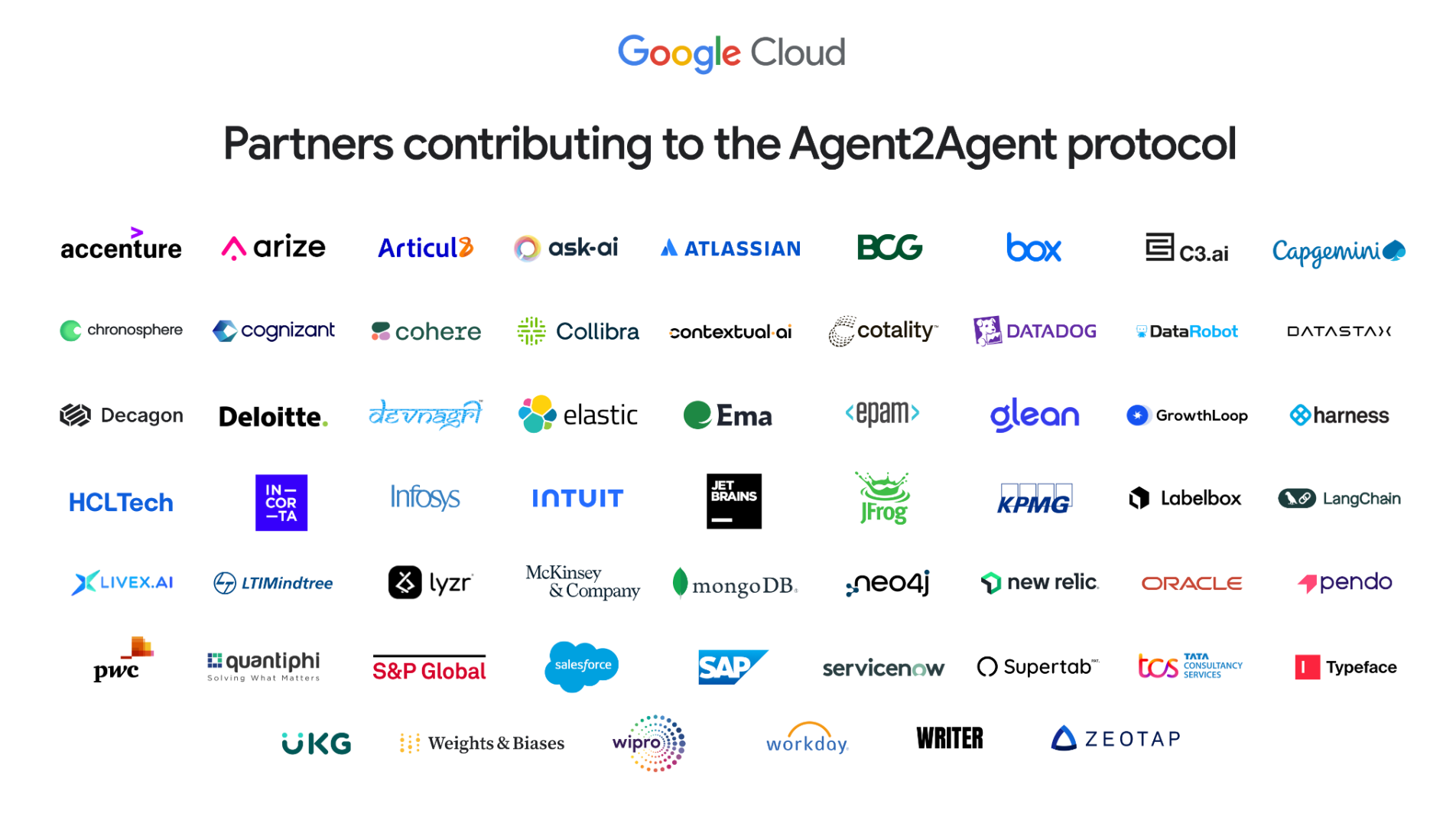
Today, we’re launching a new, open protocol called Agent2Agent (A2A), with support and contributions from more than 50 technology partners like Atlassian, Box, Cohere, Intuit, Langchain, MongoDB, PayPal, Salesforce, SAP, ServiceNow, UKG and Workday; and leading service providers including Accenture, BCG, Capgemini, Cognizant, Deloitte, HCLTech, Infosys, KPMG, McKinsey, PwC, TCS, and Wipro. The A2A protocol will allow AI agents to communicate with each other, securely exchange information, and coordinate actions on top of various enterprise platforms or applications. We believe the A2A framework will add significant value for customers, whose AI agents will now be able to work across their entire enterprise application estates.
This collaborative effort signifies a shared vision of a future when AI agents, regardless of their underlying technologies, can seamlessly collaborate to automate complex enterprise workflows and drive unprecedented levels of efficiency and innovation.
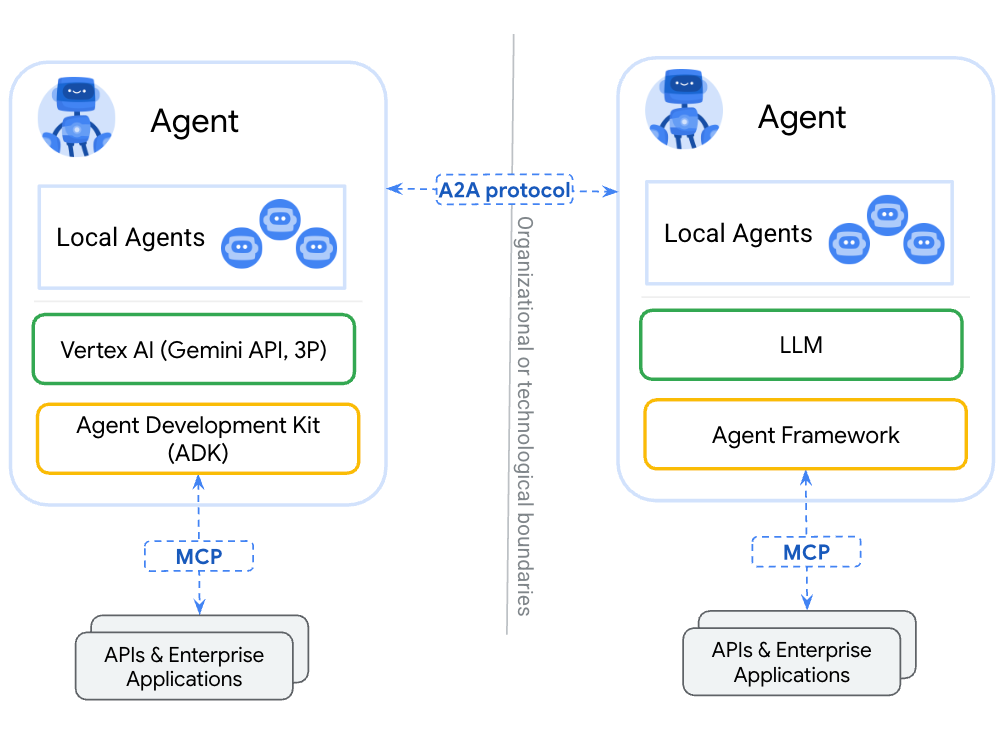
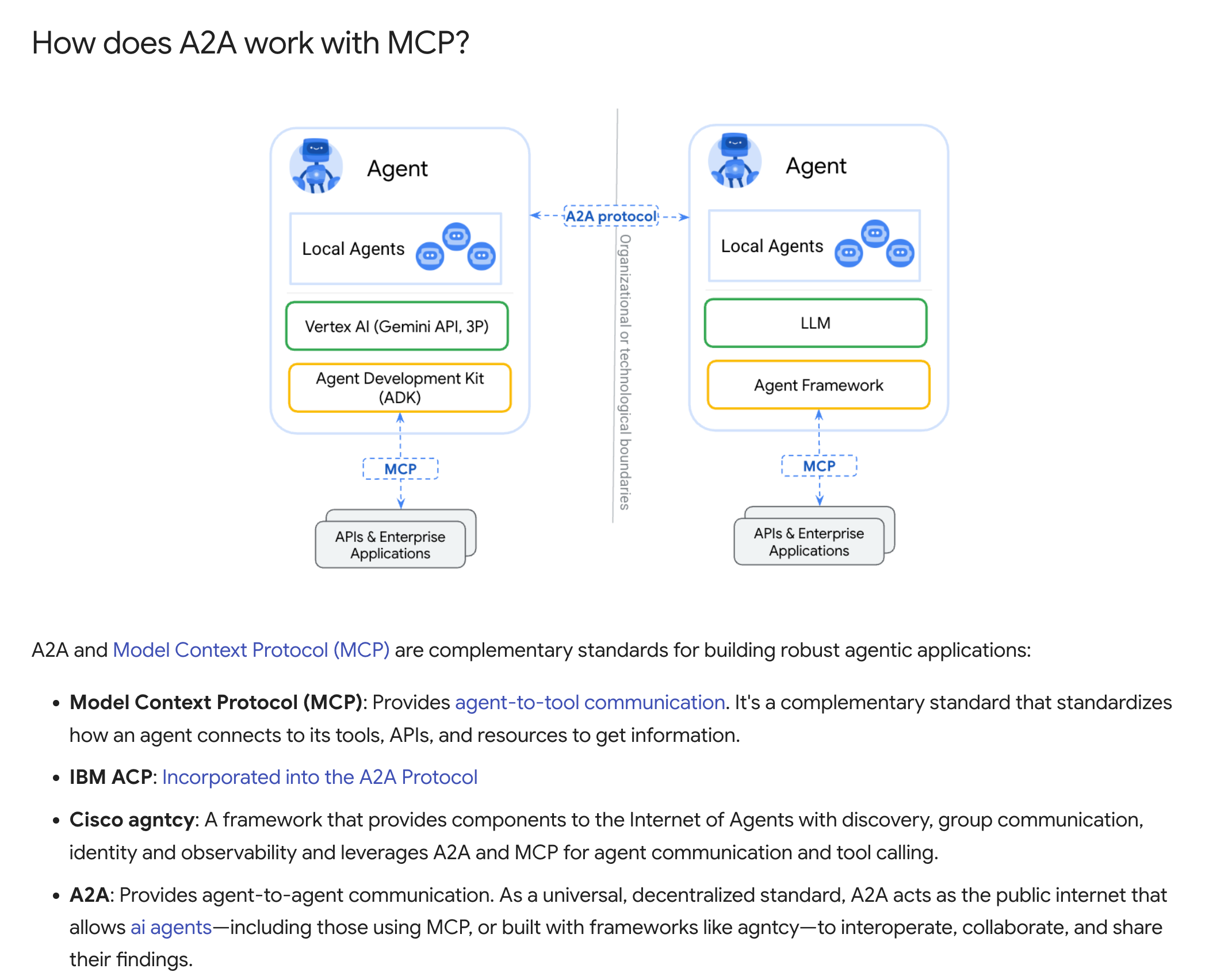
A2A is an open protocol that complements Anthropic's Model Context Protocol (MCP), which provides helpful tools and context to agents. Drawing on Google's internal expertise in scaling agentic systems, we designed the A2A protocol to address the challenges we identified in deploying large-scale, multi-agent systems for our customers. A2A empowers developers to build agents capable of connecting with any other agent built using the protocol and offers users the flexibility to combine agents from various providers. Critically, businesses benefit from a standardized method for managing their agents across diverse platforms and cloud environments. We believe this universal interoperability is essential for fully realizing the potential of collaborative AI agents.
今天我们正式推出名为Agent2Agent(A2A)的全新开放协议,该协议获得Atlassian、Box、Cohere、Intuit、Langchain、MongoDB、PayPal、Salesforce、SAP、ServiceNow、UKG和Workday等50多家技术合作伙伴的支持贡献,以及埃森哲、波士顿咨询、凯捷、高知特、德勤、HCL科技、印孚瑟斯、毕马威、麦肯锡、普华永道、塔塔咨询和维普罗等领先服务商的参与。A2A协议将实现AI智能体之间的互联互通,支持它们在不同企业平台或应用上安全交换信息并协同行动。我们相信该框架能为客户创造巨大价值,使其AI智能体得以在整个企业应用生态中协同工作。
这项合作彰显了我们共同的愿景:未来无论采用何种底层技术,AI智能体都能无缝协作,实现复杂企业工作流程的自动化,推动效率与创新达到前所未有的水平。
作为开放协议,A2A与Anthropic的模型上下文协议(MCP)形成互补,后者为智能体提供实用工具和上下文支持。借鉴谷歌在智能体系统规模化方面的内部专长,我们设计的A2A协议专门针对大规模多智能体系统部署中的实际挑战。该协议赋予开发者构建兼容性智能体的能力,用户可灵活组合不同供应商的智能体。尤为关键的是,企业将获得跨平台、跨云环境管理智能体的标准化方案。我们确信,这种普适的互操作性对充分释放协作型AI智能体的潜力至关重要。
A2A design principles
A2A is an open protocol that provides a standard way for agents to collaborate with each other, regardless of the underlying framework or vendor. While designing the protocol with our partners, we adhered to five key principles:
- Embrace agentic capabilities: A2A focuses on enabling agents to collaborate in their natural, unstructured modalities, even when they don’t share memory, tools and context. We are enabling true multi-agent scenarios without limiting an agent to a “tool.”
- Build on existing standards: The protocol is built on top of existing, popular standards including HTTP, SSE, JSON-RPC, which means it’s easier to integrate with existing IT stacks businesses already use daily.
- Secure by default: A2A is designed to support enterprise-grade authentication and authorization, with parity to OpenAPI’s authentication schemes at launch.
- Support for long-running tasks: We designed A2A to be flexible and support scenarios where it excels at completing everything from quick tasks to deep research that may take hours and or even days when humans are in the loop. Throughout this process, A2A can provide real-time feedback, notifications, and state updates to its users.
- Modality agnostic: The agentic world isn’t limited to just text, which is why we’ve designed A2A to support various modalities, including audio and video streaming.
A2A设计原则
A2A是一种开放协议,为智能体之间的协作提供了标准化方式,不受底层框架或供应商限制。在与合作伙伴共同设计该协议时,我们遵循了五大核心原则:
拥抱智能体能力:A2A专注于让智能体以其天然的、非结构化模态进行协作,即使它们不共享内存、工具和上下文。我们正在实现真正的多智能体场景,而非将智能体局限为单一"工具"。
基于现有标准:该协议构建于HTTP、SSE、JSON-RPC等广泛使用的现有标准之上,这意味着它能更轻松地与日常使用的现有IT系统集成。
默认安全机制:A2A设计支持企业级认证与授权,发布时即实现与OpenAPI认证方案的同等安全级别。
支持长时任务:A2A被设计为具备灵活性,既能处理即时任务,也能胜任需要数小时甚至数日(含人工介入环节)的深度研究任务,并在此过程中向用户提供实时反馈、通知和状态更新。
模态无关性:智能体世界不仅限于文本,因此我们设计的A2A支持包括音视频流在内的多种模态。
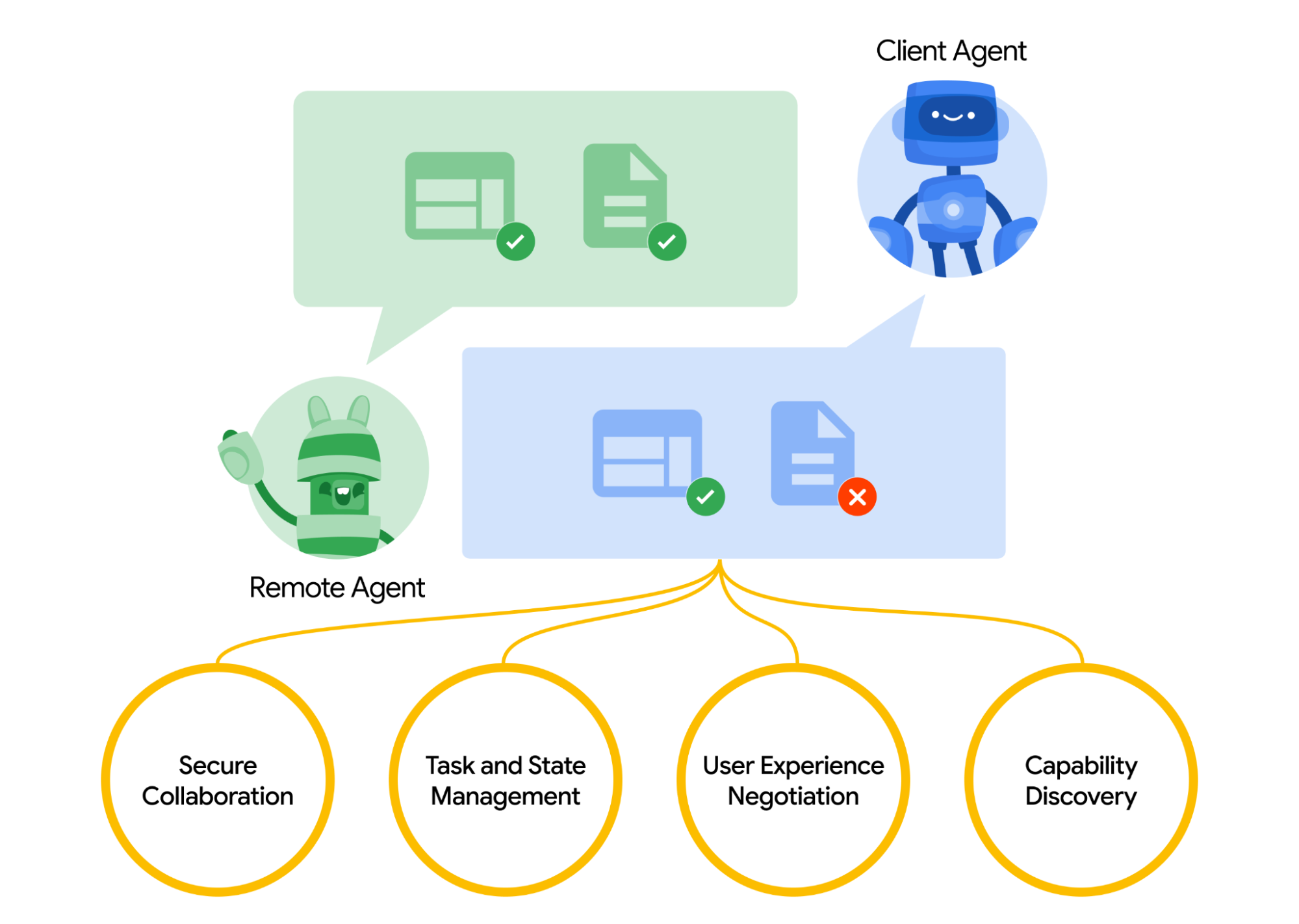
A2A facilitates communication between a "client" agent and a “remote” agent. A client agent is responsible for formulating and communicating tasks, while the remote agent is responsible for acting on those tasks in an attempt to provide the correct information or take the correct action. This interaction involves several key capabilities:
- Capability discovery: Agents can advertise their capabilities using an “Agent Card” in JSON format, allowing the client agent to identify the best agent that can perform a task and leverage A2A to communicate with the remote agent.
- Task management: The communication between a client and remote agent is oriented towards task completion, in which agents work to fulfill end-user requests. This “task” object is defined by the protocol and has a lifecycle. It can be completed immediately or, for long-running tasks, each of the agents can communicate to stay in sync with each other on the latest status of completing a task. The output of a task is known as an “artifact.”
- Collaboration: Agents can send each other messages to communicate context, replies, artifacts, or user instructions.
- User experience negotiation: Each message includes “parts,” which is a fully formed piece of content, like a generated image. Each part has a specified content type, allowing client and remote agents to negotiate the correct format needed and explicitly include negotiations of the user’s UI capabilities–e.g., iframes, video, web forms, and more.
See the full details of how the protocol works in our draft specification.
A2A促进“客户端”代理与“远程”代理之间的通信。客户端代理负责制定任务并传达任务,而远程代理则负责执行这些任务,以尝试提供正确信息或采取正确行动。这一交互涉及多项关键能力:
能力发现:代理可通过JSON格式的“代理卡片”宣传其能力,使客户端代理能识别最适合执行任务的代理,并利用A2A与远程代理通信。
任务管理:客户端与远程代理之间的通信以任务完成为导向,代理通过协作满足终端用户请求。协议定义的“任务”对象具有生命周期,可即时完成;对于长期运行的任务,各代理可通过通信保持任务最新状态的同步。任务输出称为“成果物”。
协作:代理间可通过消息传递上下文、回复、成果物或用户指令。
用户体验协商:每条消息包含“部件”——即完整内容片段(如生成的图像)。每个部件均有指定内容类型,使客户端与远程代理能协商所需格式,并明确涵盖用户界面能力的协商(例如iframe、视频、网页表单等)。完整协议机制详见我们的草案规范。
代码开源 https://github.com/a2aproject/A2A
A2A Java 工具包 https://github.com/a2aproject/a2a-java
小龙虾开发者社区是 CSDN 旗下专注 OpenClaw 生态的官方阵地,聚焦技能开发、插件实践与部署教程,为开发者提供可直接落地的方案、工具与交流平台,助力高效构建与落地 AI 应用
更多推荐
 22
22 0
0- 0


 已为社区贡献3条内容

所有评论(0)