

I have a set of simulation data where I would like to find the lowest slope in n dimensions. The spacing of the data is constant along each dimension, but not all the same (I could change that for the sake of simplicity).
I can live with some numerical inaccuracy, especially towards the edges. I would heavily prefer not to generate a spline and use that derivative; just on the raw values would be sufficient.
It is possible to calculate the first derivative with numpy using the numpy.gradient() function.
import numpy as np

data = np.random.rand(30,50,40,20)
first_derivative = np.gradient(data)
# second_derivative = ??? <--- there be kudos (:
This is a comment regarding laplace versus the hessian matrix; this is no more a question but is meant to help understanding of future readers.
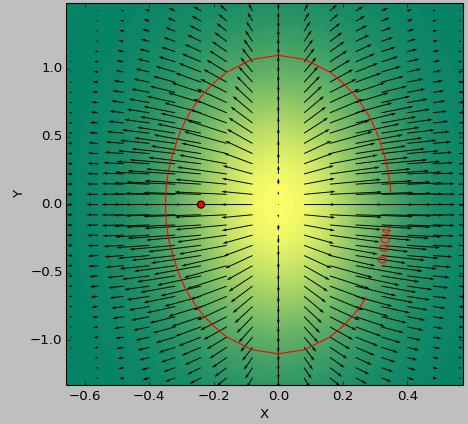
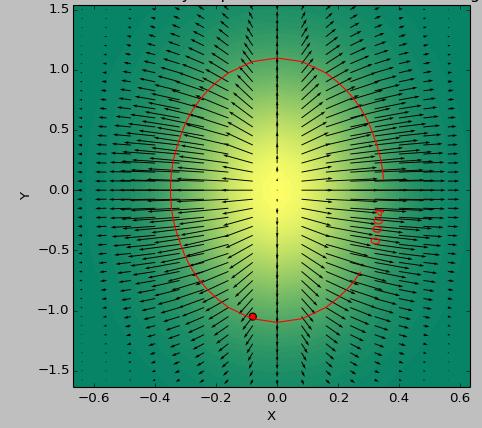
I use as a testcase a 2D function to determine the 'flattest' area below a threshold. The following pictures show the difference in results between using the minimum of second_derivative_abs = np.abs(laplace(data)) and the minimum of the following:
second_derivative_abs = np.zeros(data.shape)
hess = hessian(data)
# based on the function description; would [-1] be more appropriate?
for i in hess[0]: # calculate a norm
    for j in i[0]:
        second_derivative_abs += j*j
The color scale depicts the functions values, the arrows depict the first derivative (gradient), the red dot the point closest to zero and the red line the threshold.
The generator function for the data was ( 1-np.exp(-10*xi**2 - yi**2) )/100.0 with xi, yi being generated with np.meshgrid.
Laplace:
Hessian:



 已为社区贡献126442条内容

所有评论(0)