numpy.zeros() in Python
·
Python numpy.zeros() function returns a new array of given shape and type, where the element’s value as 0.
numpy.zeros() function arguments
The numpy.zeros() function syntax is:
zeros(shape, dtype=None, order='C')
- The shape is an int or tuple of ints to define the size of the array.
- The dtype is an optional parameter with default value as float. It’s used to specify the data type of the array, for example, int.
- The order defines the whether to store multi-dimensional array in row-major (C-style) or column-major (Fortran-style) order in memory.
Python numpy.zeros() Examples
Let’s look at some examples of creating arrays using the numpy zeros() function.
1. Creating one-dimensional array with zeros
import numpy as np

array_1d = np.zeros(3)
print(array_1d)
Output:
[0. 0. 0.]
Notice that the elements are having the default data type as the float. That’s why the zeros are 0.
2. Creating Multi-dimensional array
import numpy as np

array_2d = np.zeros((2, 3))
print(array_2d)
Output:
[[0. 0. 0.]
 [0. 0. 0.]]
3. NumPy zeros array with int data type
import numpy as np

array_2d_int = np.zeros((2, 3), dtype=int)
print(array_2d_int)
Output:
[[0 0 0]
 [0 0 0]]
4. NumPy Array with Tuple Data Type and Zeroes
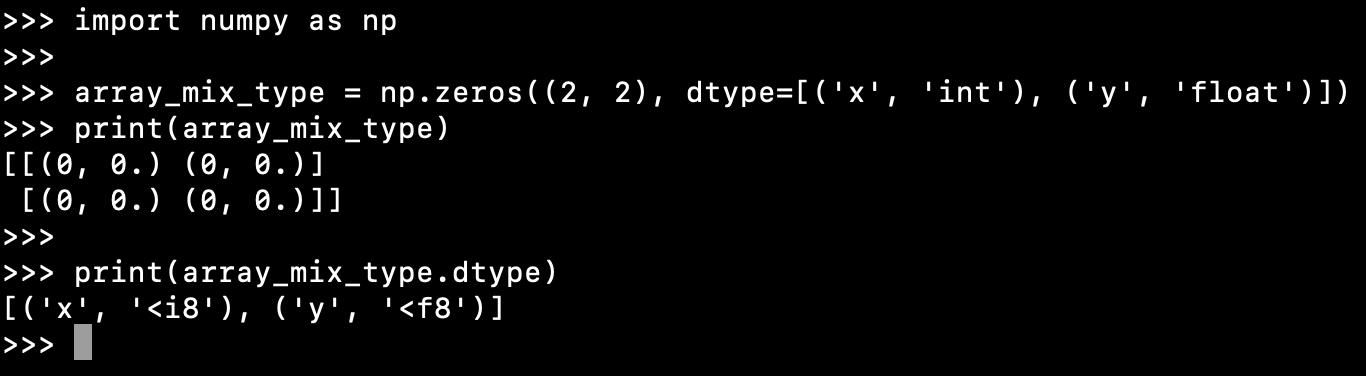
We can specify the array elements as a tuple and specify their data types too.
import numpy as np

array_mix_type = np.zeros((2, 2), dtype=[('x', 'int'), ('y', 'float')])
print(array_mix_type)
print(array_mix_type.dtype)
Output:
[[(0, 0.) (0, 0.)]
 [(0, 0.) (0, 0.)]]
[('x', '<i8'), ('y', '<f8')]
Reference: API Doc

Python社区为您提供最前沿的新闻资讯和知识内容
更多推荐

 0
0 0
0- 0


 已为社区贡献126446条内容

所有评论(0)