

I've seen scenarios where requests from one workload, sent to a ClusterIP service for another workload with no affinities set, only get routed to a subset of the associated pods. The Endpoints object for this service does show all of the pod IPs.
I did a little experiment to figure out what is happening.
Experiment
I set up minikube to have a "router" workload with 3 replicas sending requests to a "backend" workload also with 3 pods. The router just sends a request to the service name like http://backend.
I sent 100 requests to the router service via http://$MINIKUBE_IP:$NODE_PORT, since it's exposed as a NodePort service. Then I observed which backend pods actually handled requests. I repeated this test multiple times.
In most cases, only 2 backend pods handled any requests, with the occasional case where all 3 did. I didn't see any where all requests went to one in these experiments, though I have seen it happen before running other tests in AKS.
This led me to the theory that the router is keeping a persistent connection to the backend pod it connects to. Given there are 3 routers and 3 backends, there's an 11% chance all 3 routers "stick" to a single backend, a 67% chance that between the 3 routers, they stick to 2 of the backends, and a 22% chance that each router sticks to a different backend pod (1-to-1).
Here's one possible combination of router-to-backend connections (out of 27 possible): 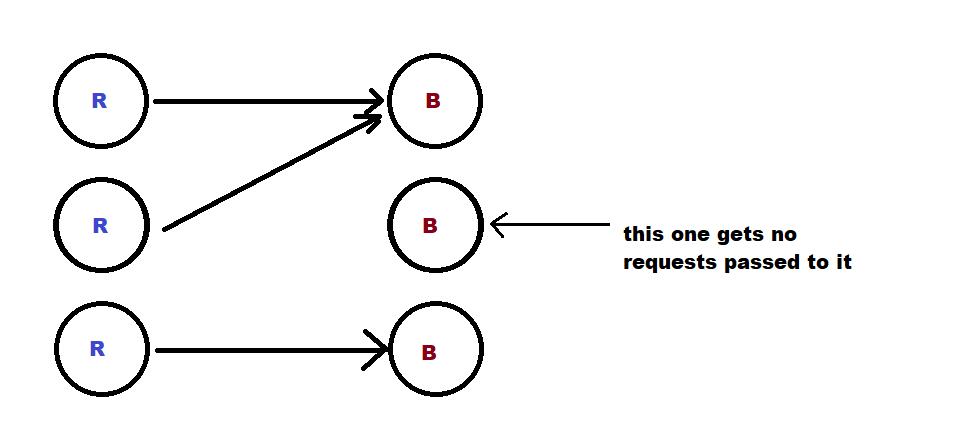
Disabling HTTP Keep-Alive
If I use a Transport disabling HTTP Keep-Alives in the router's http client, then any requests I make to the router are uniformly distributed between the different backends on every test run as desired.
client := http.Client{
    Transport: &http.Transport{
        DisableKeepAlives: true,
    },
}
resp, err := client.Get("http://backend")
So the theory seems accurate. But here's my question:
- How does the router using HTTP KeepAlive / persistent connections actually result in a single connection between one router pod and one backend pod?
- There is a
kube-proxyin the middle, so I'd expect any persistent connections to be between the router pod andkube-proxyas well as betweenkube-proxyand the backend pods. - Also, when the router does a DNS lookup, it's going to find the Cluster IP of the backend service every time, so how can it "stick" to a Pod if it doesn't know the Pod IP?
- There is a
Using Kubernetes 1.17.7.


 已为社区贡献20439条内容

所有评论(0)