
Does gRPC vs NATS or Kafka make any sense?
Answer a question
For a long time, when it comes to the microservice architecture, NATS and Kafka are the first options that come to my mind. But recently I found this gRPC template in dotnet core and that grasped my attention. I read a lot about it and watched a lot of videos but I don't think any of those could address gRPC correctly as they usually contrast between gRPC and message brokers or protocols such as REST which I guess is pretty inappropriate although SOAP would be relevant here. My assumption is that gRPC is a modern version of SOAP with better performance and less implementation hassle due to it protocol buffer. And I think that gRPC can by no means be compared against Kafka or NATS. And also that it cannot replace RESTful service as neither could SOAP.
Now, the question, to what extent are my assumptions true? For example, when it comes to selecting a communication bridge between nodes on a cluster, do I have to put gPRC among my options now (NATS, Kafkam Rabbit, etc) or should I consider that when creating a web proxy to bridge external request to my microservices?
Finally, how about real-time communication, can gRPC replace websocket/socket.io/signalR completely? What does it replace?
Answers
I often see people misplacing these technologies by one crucial aspect: public authentication.
For instance, check this graph: 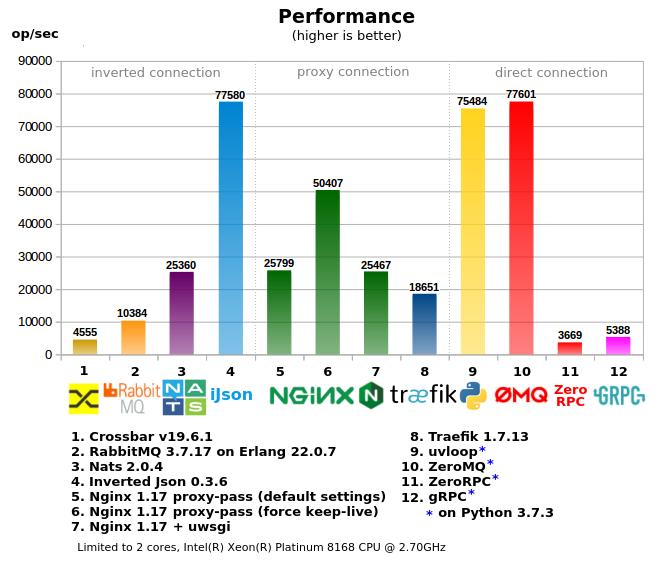
This is a benchmark of Inverted Json (https://github.com/lega911/ijson), comparing some tools, such as iJson, RabbitMQ, Nats, 0MQ, etc.
Notice that Nats, ZeroMQ and iJson are not meant to be used as public end-points (for instance, Nats have user/password, token and keys, but it is useless in an open environment, such as web browsers, because there is no way to make the key non public).
On the other hand, GRPC works just fine with JWT and Oauth2, making it completely safe to public end-points (as safer as any other HTTP endpoint), 'cos those tokens are server-signed (so, even tough they are public, they can't be forged or tempered with)
So, what I'm trying to say is: there are techs meant to face public and techs meant to glue together servers and process within servers (which are private connections).
GRPC is public, ZeroMQ and iJson are totally private (iJson, for instance, don't have any kind of authentication). Nats works with keys or passwords, so, although is "safer" than iJson and ZeroMQ, it is not meant to be public.
When you say REST (I'm assuming HTTP here, because REST is just an architecture), websocket/socket.io/signalR, you are depicting all public interfaces. GRPC will cover you here (it's comparable to REST as request/response and websocket/socket.io/signalR because it supports half and full duplex streaming (similar to sockets)).
Nats, iJson, ZeroMQ, on the other hand, are not meant to do that. They are meant to communicate between services.
So, basically, REST/websocket/socket.io/signalR = gRPC.
Internal communication between services (in the same or in different servers) = NATs, iJSON, ZeroMQ.
(notice that I'm not even considering the other technologies in the graph, because they are products, IMO, not simple libraries you can use to achieve an end, such as RabbitMQ, nginx, etc. The other ones I'm not familiar enough to be able to make an opinion (but I'm surprised by the uvloop in that graph)).

华为、百度、京东云现已入驻,来创建你的专属开发者社区吧!
更多推荐
 0
0 0
0- 0


 已为社区贡献20424条内容

所有评论(0)