
Java数据结构6(队列和二叉树初步)
目录
1,队列的性质
2,循环队列
3,队列链式存储
4,树的性质
5,二叉树的遍历
6,代码实现
一,队列的性质
同样是线性表,队列有线性表的相关操作,不过不同的是队列的性质为先进先出,类似为排队一样
队列的主要方法如下
| 方法 | 作用 | 特点 |
|---|---|---|
offer(E e) |
入队(添加元素到队尾) | 成功返回 true,失败返回 false(不抛异常) |
poll() |
出队(删除并返回队首元素) | 队列为空时返回null |
peek() |
查看队首元素(不删除) | 队列为空时返回null |
add(E e) |
入队 | 失败时直接抛出异常 |
remove() |
出队 |
队列为空时直接抛出异常 |
     Queue<Integer> queue=new ArrayDeque<>();
        queue.offer(1);
        queue.offer(2);
        queue.offer(3);
        System.out.println(queue);
        queue.poll();
        System.out.println(queue);
        System.out.println(queue.peek());
        System.out.println(queue.isEmpty());
二,循环队列
因为队列顺序存储存在不足,当你出元素的时候是从头开始出,你的头就会顺着延续给下一个元素,头的指向就会不断往后走,所以你前面的位置就空出来了,会造成空间的浪费,所以我们可以使用循环的方式来实现空间的利用
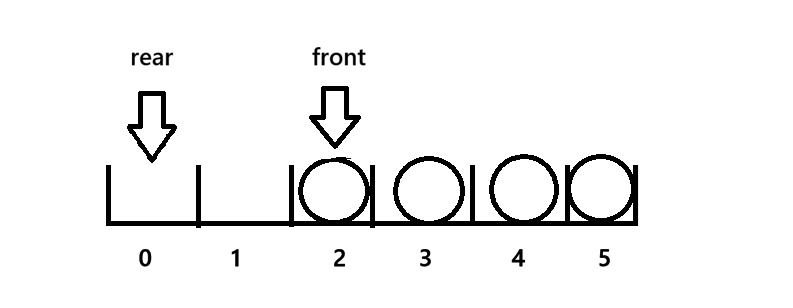
类似这样的结构,当我们删除元素的时候,front往后走,rear也往后走,当我们加元素的时候,front和rear都往前走,当rear下下一个元素就是front的时候,我们就放满了,为什么这样就满了而不是放满呢,因为当放满的时候,rear就会和front重合,但是当一个元素没有的时候,rear和front也是重合的,就不太好区分,所以选择牺牲一个空间
在代码的实现中有几个注意的点(rear和front都是下标,capacity是总长度,比最多能放的元素多一)
1,队列满的条件是(rear+1)%capacity==front,也就是要rear的下一个元素是front,因为小%大=小,所以+1再%大就是rear+1,当这时候两者相等了,就可以说明满了
2,(rear+1)%capacity也是入队时的rear的循环语句
3,计算长度:在计算长度的时候会出现以下两种情况,第一种情况被分为了两部分,一个1和一个4,分别为rear+1(1)以及capacity-front(6-2),所以图一的个数为rear-front+capacity,图二就是rear-front(5-0),所以综合下来的公式就是(rear-front+capacity)%capacity
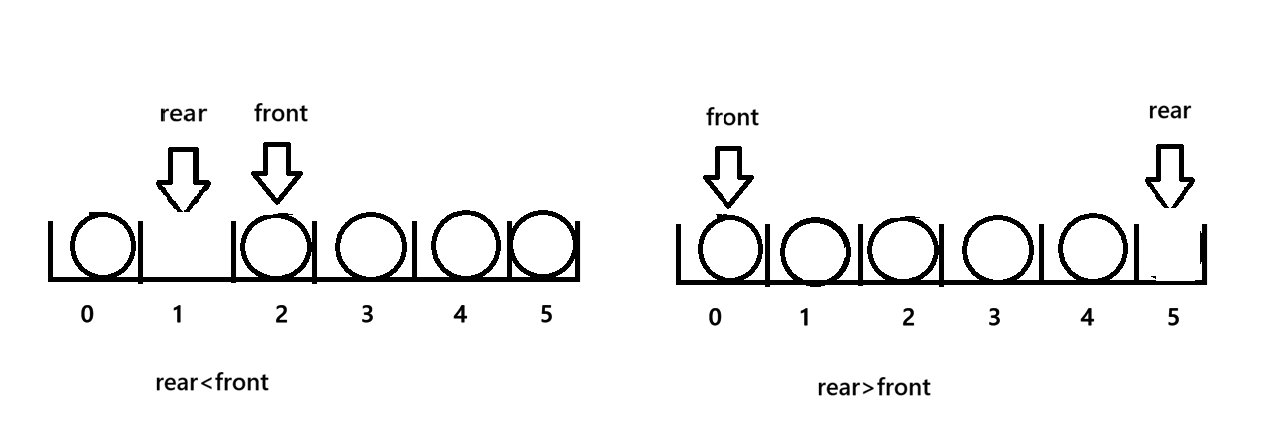
这样我们的代码就如下
public class CircleQueue {
    private int arr[];
    private int front;
    private int rear;
    private int capacity;
    public CircleQueue(int maxSize) {
        // maxSize为最多放的元素,预留一个空闲元素,所以+1
        capacity = maxSize + 1;
        arr = new int[capacity];
        front = 0;
        rear = 0;
    }
    public boolean isEmpty() {
        return front == rear;
    }
    public boolean isFull() {
        return (rear + 1) % capacity == front;
    }
    //入队,相当于offer
    public void enQueue(int val){
        if (isFull()){
            return;
        }
        arr[rear]=val;
        rear=(rear+1)%capacity;
    }
    //出队,相当于pop
    public void deQueue(){
        if (isEmpty()){
            throw new RuntimeException("队列为空");
        }
        front=(front+1)%capacity;
    }
    //拿头元素,相当于peek
    public int getFront(){
        if (isEmpty()){
            throw new RuntimeException("队列为空");
        }
        return arr[front];

    }
    //遍历
    public void showQueue(){
        if (isEmpty()) {
            System.out.println("队列为空");
            return;
        }
        // 从front开始遍历,遍历有效元素个数
        for (int i = front; i != rear; i = (i + 1) % capacity) {
            System.out.print(arr[i] + " ");
        }
        System.out.println();
    }

    public static void main(String[] args) {
        CircleQueue circleQueue=new CircleQueue(5);
        circleQueue.enQueue(1);
        circleQueue.enQueue(2);
        circleQueue.enQueue(3);
        circleQueue.enQueue(4);
        circleQueue.enQueue(5);
        circleQueue.showQueue();
        circleQueue.deQueue();
        circleQueue.showQueue();
        System.out.println(circleQueue.getFront());
    }
}
三,队列的链式存储
因为上面的方法会牺牲一个空间,并且规定了总空间,不够灵活,所以我们可以通过链式存储,也就是简单的单项链表,使用尾插法,并且删除时候是删除前面,以下是代码,和我前面一篇自己实现单项链表的文章内容差不多
public class Node {
    static class ListNode {
        public int val;
        public ListNode prev;
        public ListNode next;

        public ListNode(int val) {
            this.val = val;
        }
    }
    public ListNode first;
    public ListNode last;
    //入队
    public void offer(int val){
        ListNode listNode=new ListNode(val);
        if (first==null){
            first=last=listNode;
        }
        last.next=listNode;
        listNode.prev=last;
        last=listNode;
    }
    //获取头元素并且删除
    public int poll(){
        if (first==null){
            throw new RuntimeException("为空");
        }
        int val= first.val;
        if (first==last){
            first=null;
            last=null;
        }
        first=first.next;
        first.prev=null;
        return val;
    }
    //获取头元素
    public int peek(){
        if (first==null){
            throw new RuntimeException("为空");
        }
        return first.val;
    }

    public int size(){
        ListNode cur=first;
        int count=0;
        while (cur!=null){
            cur=cur.next;
            count++;
        }
        return count;
    }
    public boolean empty(){
        return first==null;
    }
    public void showQueue(Node node){
        ListNode cur=first;
        while (cur!=null){
            System.out.print(cur.val+" ");
            cur=cur.next;
        }
        System.out.println();
    }


    public static void main(String[] args) {
        Node node=new Node();
        node.offer(1);
        node.offer(2);
        node.offer(3);
        System.out.println(node.peek());
        node.showQueue(node);
        node.poll();
        node.showQueue(node);
    }
}
四,树的相关性质
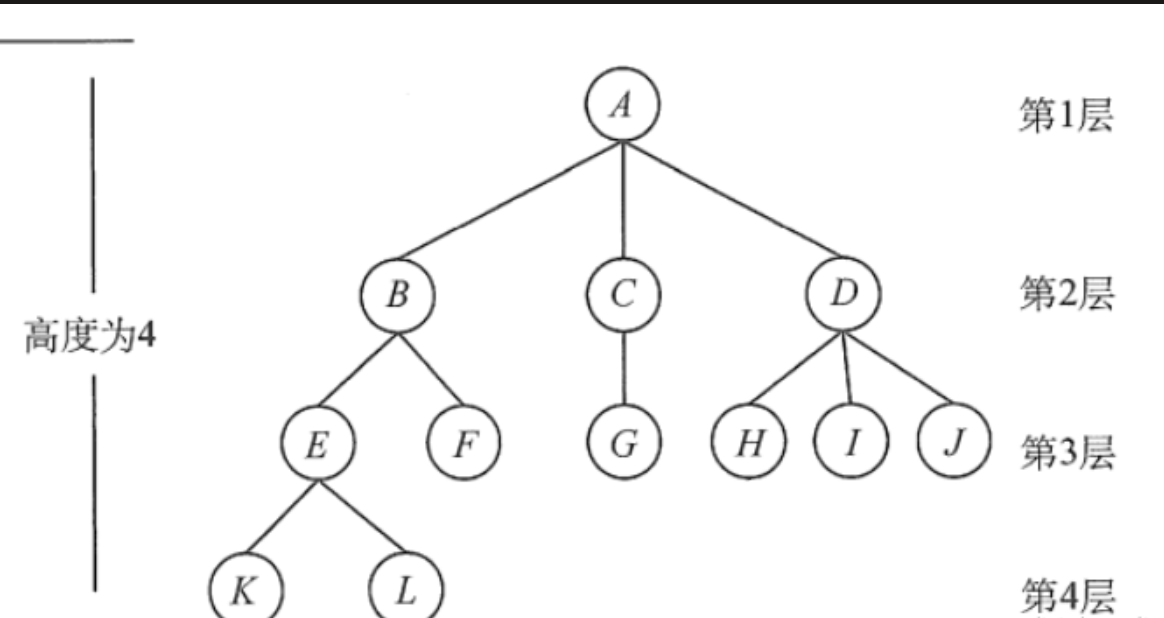
(1)、树的定义
树(Tree) 是n(n≥0)个结点的有限集合,满足:
- 若 n=0:称为空树;
- 若 n>0:
- 有且仅有一个根结点;
- 其余结点可分为互不相交的有限集合,每个集合本身又是一棵树,称为根的子树。
- 特点:层次结构、一对多;区别于线性表(一对一)、图(多对多)
我们根据上图来引出相关定义
结点的度:一个结点含有子树的个数,如上图:A的度为3;
树的度:一棵树中节点度的最大值,如上图:树的度为3;
叶子结点或终端结点:度为0的结点称为叶结点;
双亲结点或父结点:若一个结点含有子结点,那么称为这个子结点的父结点;
根结点:没有父结点的结点,图中为A;
结点的层次:从根开始定义,根为第一层,根的子结点为第二层;
树的高度:树中结点的最大层次,图中为4;
非终端结点:度不为0的结点;
二叉树
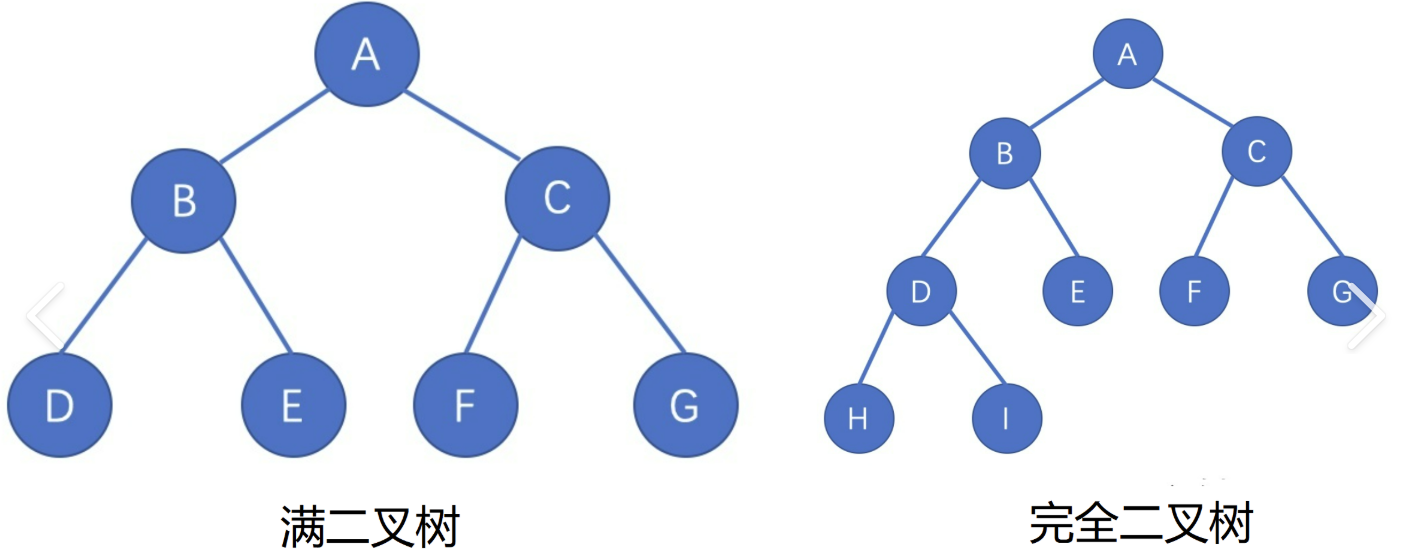
(1)、基本定义特点
- 每个节点最多有两个子节点,分别叫左孩子、右孩子。
- 子节点有左右次序,不能随意互换,是有序树。
- 可以是空二叉树;单个节点也是二叉树。
(2)、特殊二叉树特点
-
满二叉树每层节点都满,所有叶子在最底层,非叶子都有左右两个孩子。
-
完全二叉树除最后一层外,其余层节点全满;最后一层节点靠左连续排列。
- 叶子只出现在最下两层
- 度为 1 的节点最多只有 1 个
(3)、二叉树的性质
1,二叉树的第i层上至多有2^(i-1)个结点
2,如果有k层,二叉树至多有2^k-1个结点
3,对于任何一颗二叉树,如果终端结点树4为n0,度为2的结点数为n2,则n0=n2+1
4,具有n个结点的完全二叉树的深度为【log2n】+1
5,如果有n个结点的完全二叉树,对任意结点i有:
(1)如果i=1,则结点i是二叉树的根;如果i>1,则其双亲结点为i/2
(2)如果2i>n,则结点i无左孩子,否则其左孩子结点为2i
(3)如果2i+1>n,则结点i无右孩子,否则其右孩子结点为2i+1
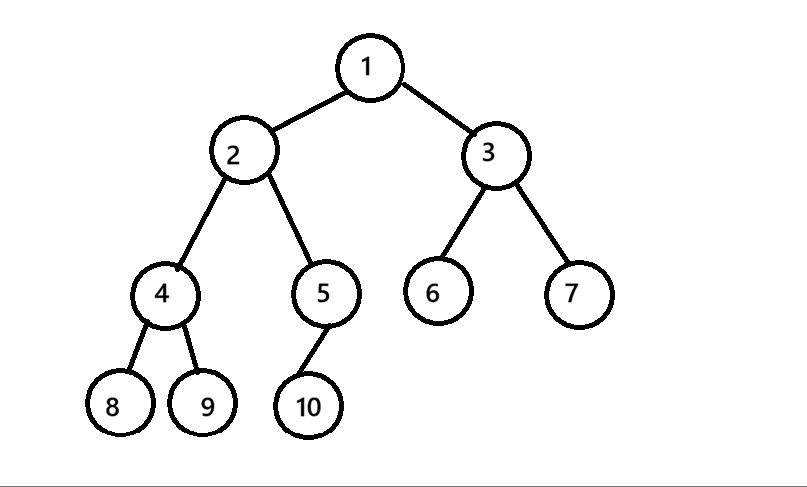
以这个完全二叉树为例(上图为完全二叉树)
(1)1是其根结点,当i=3>1的时候,其双亲结点为3/2=1
(2)当i=6的时候,没有左孩子,当i=5,2i=10不大于n,左孩子结点为10
(3)当i=5的时候,没有右孩子,当i=3的时候右孩子为7
(4)、二叉树相关练习
1.某⼆叉树共有 399 个结点,其中有 199 个度为 2 的结点,则该⼆叉树中的叶⼦结点数为( )
A 不存在这样的⼆叉树 B 200 C 198 D 199
2.在具有 2n 个结点的完全⼆叉树中,叶⼦结点个数为( )
A n B n+1 C n-1 D n/2
3.⼀个具有767个节点的完全⼆叉树,其叶⼦节点个数为()
A 383 B 384 C 385 D 386
4.⼀棵完全⼆叉树的节点数为531个,那么这棵树的⾼度为( )
A 11 B 10 C 8 D 12
答案: 1.B 2.A 3.B 4.B
答:题1:根据性质3可知,n0=n2+1,所以叶子结点也就是n0,就等于200
题2:以上面图片的完全二叉树可以知道,当总结点数为偶数的时候,是有一个单独的左结点的,也就是有一个单独的度为1的结点,所以2n=1+n0+n2,然后又因为n0=n2+1,所以n0=n
题3:第3题也和第2题一样
题4:根据性质4可以计算出来,并且深度是要取大的
五,二叉树的遍历
(1)遍历方式:
二叉树的遍历主要是以前中后遍历(主要是看根的位置在哪)
前序遍历:根-->左-->右
中序遍历:左-->根-->右
后序遍历:左-->右-->根
在我们从根或者左右到达一个新的结点的时候,我们都要把它看成一个完整的二叉树来再看它的左右,就如同递归一样,我们还是以这一颗二叉树为例
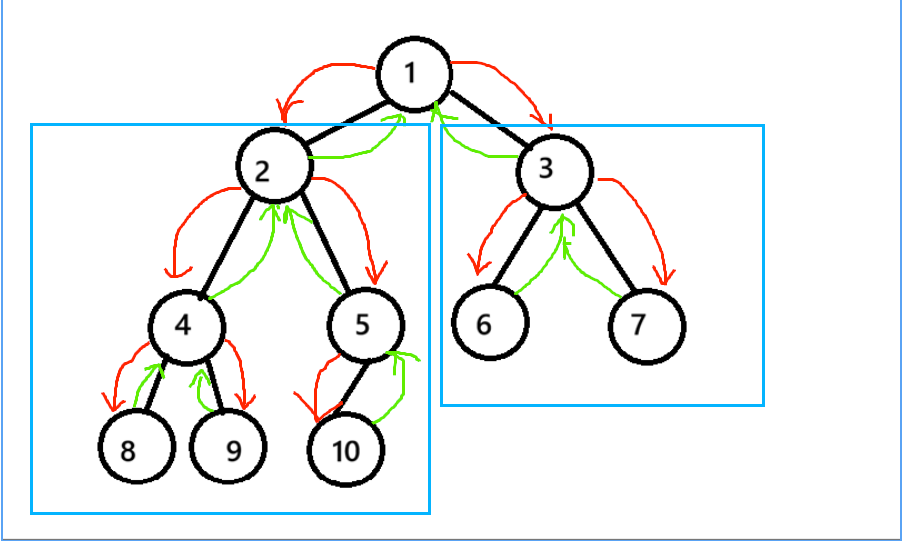
前序遍历1 → 2 → 4 → 8 → 9 → 5 → 10 → 3 → 6 → 7
我们以前序遍历为例:先是根1,打印1,然后遍历1的左边,然后把左边看成新树,以此类推,打印2,打印4,打印8,然后就是4的右边,打印9,打印5,然后打印10,再到1的右边,打印3,打印6最后打印7
(2)例题:
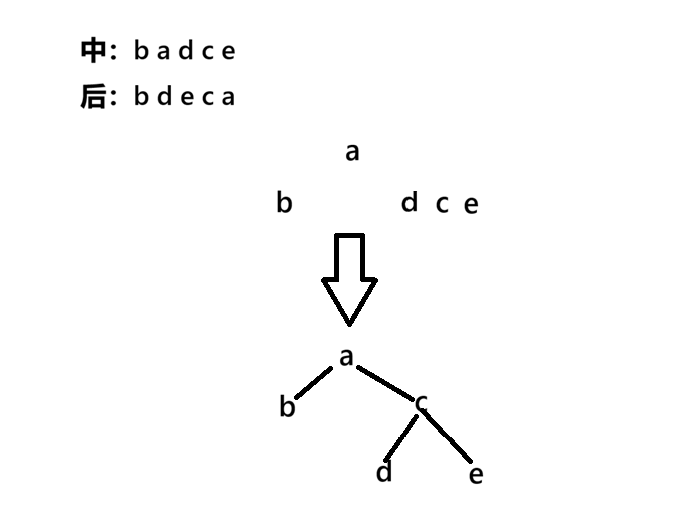
设⼀课⼆叉树的中序遍历序列:badce,后序遍历序列:bdeca,则⼆叉树前序遍历序列为()
A: adbce B: decab C: debac D: abcde
答:根据后序遍历的特点,可以知道根为a,所以再根据中序遍历根在中间的特点,所以b在a的左边,dce在a的右边,然后单独看后续遍历中的dec,可以知道,dec这颗完整的树中,c是根,d是左,e是右,最终会如下图
六,代码实现
我们先纯手搓一个二叉树,二叉树还是这个图中的,代码如下
public class BinaryTree {
    static class TreeNode{
        public int val;
        public TreeNode left;
        public TreeNode right;

        public TreeNode(int val) {
            this.val = val;
        }
    }
    public TreeNode CrateTree(){
        TreeNode treeNode1=new TreeNode(1);
        TreeNode treeNode2=new TreeNode(2);
        TreeNode treeNode3=new TreeNode(3);
        TreeNode treeNode4=new TreeNode(4);
        TreeNode treeNode5=new TreeNode(5);
        TreeNode treeNode6=new TreeNode(6);
        TreeNode treeNode7=new TreeNode(7);
        TreeNode treeNode8=new TreeNode(8);
        TreeNode treeNode9=new TreeNode(9);
        TreeNode treeNode10=new TreeNode(10);
        treeNode1.left=treeNode2;
        treeNode2.left=treeNode4;
        treeNode4.left=treeNode8;
        treeNode4.right=treeNode9;
        treeNode2.right=treeNode5;
        treeNode5.left=treeNode10;
        treeNode1.right=treeNode3;
        treeNode3.left=treeNode6;
        treeNode3.right=treeNode7;
        return treeNode1;
    }
然后我们通过递归来实现前中后序遍历
public void preorder(TreeNode root){
        if (root==null){
            return;
        }
        System.out.print(root.val+" ");
        preorder(root.left);
        preorder(root.right);
    }
    //中
    public void inorder(TreeNode root){
        if (root==null){
            return;
        }
        inorder(root.left);
        System.out.print(root+" ");
        inorder(root.right);
    }
    public void postorder(TreeNode root){
        if (root==null){
            return;
        }
        postorder(root.left);
        postorder(root.right);
        System.out.print(root+" ");
    }
public class Test {
public static void main(String[] args) {
BinaryTree binaryTree=new BinaryTree();
BinaryTree.TreeNode ROOT=binaryTree.CrateTree();
binaryTree.preorder(ROOT);
}
}
更多推荐
 11
11 0
0- 0


 已为社区贡献2条内容

所有评论(0)