
机器学习——决策树剪枝
一、引言
在机器学习的世界中,决策树因其直观易懂的特性而广受欢迎。然而,就像一棵自然生长的树木需要修剪才能茁壮成长一样,决策树模型也需要"剪枝"来避免过拟合(Overfitting),提高泛化能力。今天,我们将深入探讨决策树剪枝的技术、原理和实践应用。
二、什么是过拟合
想象一下,一个学生为了通过考试,不是理解概念,而是死记硬背了所有练习题和答案。当遇到新问题时,他就不知所措了。这就是过拟合!
在决策树中,过拟合表现为:
-
树过于复杂,分支过多
-
完美拟合训练数据,但在测试数据上表现差
-
捕捉了噪声而不是规律
可视化示例:
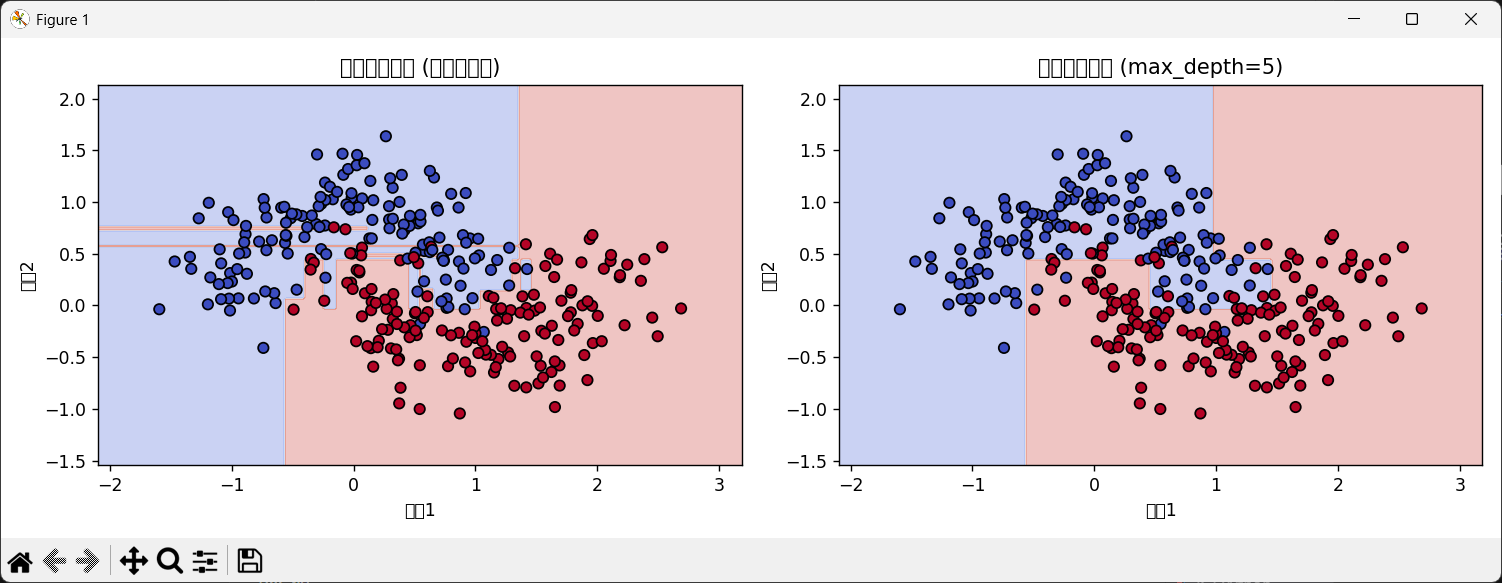
三、决策树剪枝的两种主要方法
1.
1. 预剪枝 (Pre-pruning)
在树生长过程中提前停止,防止过度生长。
from sklearn.tree import DecisionTreeClassifier

# 创建带有预剪枝参数的决策树
tree = DecisionTreeClassifier(
    # 1. 最大深度控制 - 限制树的生长高度
    max_depth=5,  # 树的最大深度

    # 2. 最小样本分裂 - 节点至少有多少样本才考虑分裂
    min_samples_split=20,  # 节点最少需要20个样本才分裂

    # 3. 最小样本叶子 - 叶节点最少需要多少样本
    min_samples_leaf=10,  # 每个叶节点至少10个样本

    # 4. 最大叶子节点数 - 限制叶节点的总数
    max_leaf_nodes=31,  # 最多31个叶节点(二叉树:2^5-1)

    # 5. 分裂最小不纯度减少量
    min_impurity_decrease=0.01,  # 分裂必须使不纯度减少至少0.01

    # 6. 最大特征数 - 随机森林中常用
    max_features='sqrt',  # 每次分裂考虑的特征数为总特征数的平方根

    random_state=42
)
2. 后剪枝 (Post-pruning)
先让树完全生长,然后从底部开始剪掉不必要的分支。
sklearn中的代价复杂度剪枝 (Cost-Complexity Pruning)
import numpy as np
from sklearn.tree import DecisionTreeClassifier
from sklearn.model_selection import train_test_split
from sklearn.datasets import load_breast_cancer

# 加载数据
data = load_breast_cancer()
X, y = data.data, data.target
X_train, X_test, y_train, y_test = train_test_split(X, y, test_size=0.3, random_state=42)

# 让树完全生长
tree_full = DecisionTreeClassifier(random_state=42, max_depth=None)
tree_full.fit(X_train, y_train)

# 获取剪枝路径
path = tree_full.cost_complexity_pruning_path(X_train, y_train)
ccp_alphas, impurities = path.ccp_alphas, path.impurities

print(f"找到 {len(ccp_alphas)} 个alpha值可用于剪枝")
print(f"Alpha范围: {ccp_alphas.min():.6f} 到 {ccp_alphas.max():.6f}")

# 为每个alpha值训练一个树
trees = []
for ccp_alpha in ccp_alphas:
    tree = DecisionTreeClassifier(random_state=42, ccp_alpha=ccp_alpha)
    tree.fit(X_train, y_train)
    trees.append(tree)

# 移除最后一个树(只有一个节点)
trees = trees[:-1]
ccp_alphas = ccp_alphas[:-1]

# 评估不同alpha值的性能
train_scores = [tree.score(X_train, y_train) for tree in trees]
test_scores = [tree.score(X_test, y_test) for tree in trees]

# 可视化
fig, (ax1, ax2) = plt.subplots(1, 2, figsize=(12, 4))

# 准确率 vs Alpha
ax1.plot(ccp_alphas, train_scores, marker='o', label='训练集', drawstyle="steps-post")
ax1.plot(ccp_alphas, test_scores, marker='s', label='测试集', drawstyle="steps-post")
ax1.set_xlabel("Alpha (正则化参数)")
ax1.set_ylabel("准确率")
ax1.set_title("不同Alpha值的模型性能")
ax1.legend()
ax1.grid(True, alpha=0.3)

# 树节点数 vs Alpha
node_counts = [tree.tree_.node_count for tree in trees]
ax2.plot(ccp_alphas, node_counts, marker='o', drawstyle="steps-post")
ax2.set_xlabel("Alpha (正则化参数)")
ax2.set_ylabel("节点数量")
ax2.set_title("树复杂度 vs Alpha")
ax2.grid(True, alpha=0.3)

plt.tight_layout()
plt.show()

# 找到最优alpha值
best_idx = np.argmax(test_scores)
best_alpha = ccp_alphas[best_idx]
print(f"\n最优Alpha值: {best_alpha:.6f}")
print(f"最优测试准确率: {test_scores[best_idx]:.4f}")
print(f"对应训练准确率: {train_scores[best_idx]:.4f}")
print(f"树节点数: {node_counts[best_idx]}")
四、应用
以以下数据作数据集,用决策树剪枝来解决该问题:
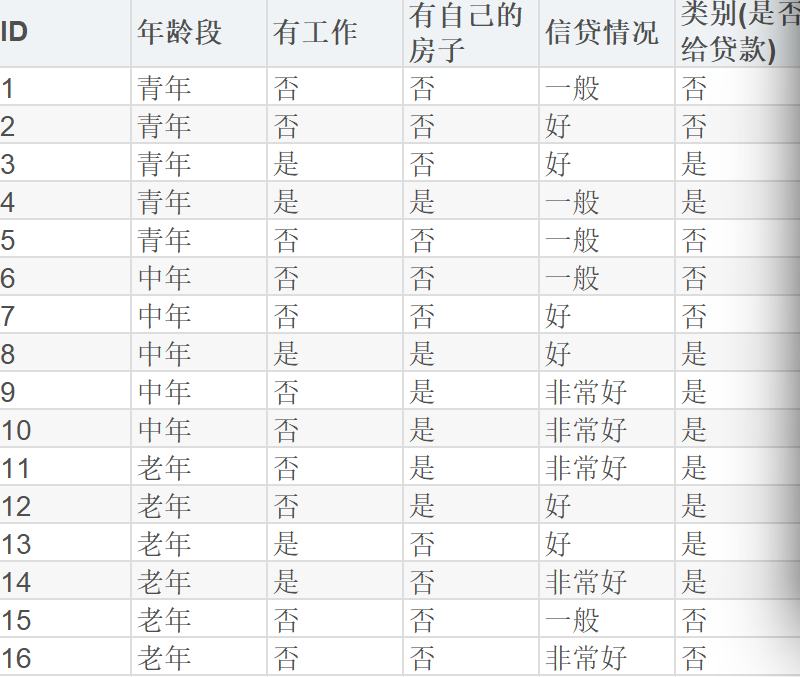
完整代码:
import math
import pandas as pd
import numpy as np
from collections import Counter

class DecisionTree:
    def __init__(self, criterion='info_gain', max_depth=None, min_samples_split=2,
                 min_samples_leaf=1, pruning='post', alpha=0.1):
        self.criterion = criterion  # 'info_gain' or 'gain_ratio'
        self.max_depth = max_depth  # 预剪枝:最大深度
        self.min_samples_split = min_samples_split  # 预剪枝:分裂所需最小样本数
        self.min_samples_leaf = min_samples_leaf  # 预剪枝:叶节点最小样本数
        self.pruning = pruning  # 剪枝方式:'pre'(预剪枝)、'post'(后剪枝)、None(不剪枝)
        self.alpha = alpha  # 后剪枝惩罚系数
        self.tree = None
        self.feature_names = ['年龄段', '有工作', '有自己的房子', '信贷情况']
        self.train_data = None  # 保存训练数据用于后剪枝
        self.train_labels = None

    def fit(self, X, y):
        # 数据校验
        if len(X) == 0 or len(y) == 0 or len(X) != len(y):
            raise ValueError("训练数据为空或特征与标签长度不匹配")

        self.train_data = X
        self.train_labels = y
        # 构建原始树
        self.tree = self._build_tree(X, y, depth=0)
        # 后剪枝
        if self.pruning == 'post':
            self.tree = self._post_prune(self.tree, X, y)

    def predict(self, X):
        # 空输入处理
        if len(X) == 0:
            return []
        return [self._predict_single(x, self.tree) for x in X]

    def _entropy(self, y):
        """计算熵"""
        counter = Counter(y)
        entropy = 0.0
        for count in counter.values():
            p = count / len(y)
            entropy -= p * math.log2(p) if p > 0 else 0
        return entropy

    def _information_gain(self, X, y, feature_idx):
        """计算信息增益/增益率"""
        base_entropy = self._entropy(y)

        # 获取该特征的所有取值
        feature_values = [x[feature_idx] for x in X]
        unique_values = set(feature_values)

        # 计算按该特征分割后的条件熵
        conditional_entropy = 0.0
        split_info = 0.0

        for value in unique_values:
            sub_y = [y[i] for i in range(len(X)) if X[i][feature_idx] == value]
            if len(sub_y) == 0:
                continue

            p = len(sub_y) / len(y)
            conditional_entropy += p * self._entropy(sub_y)

            # 计算分裂信息(用于增益率)
            if self.criterion == 'gain_ratio':
                split_info -= p * math.log2(p) if p > 0 else 0

        info_gain = base_entropy - conditional_entropy

        if self.criterion == 'gain_ratio':
            if split_info == 0:  # 避免除零
                return 0
            return info_gain / split_info
        else:
            return info_gain

    def _majority_vote(self, y):
        """多数投票"""
        if len(y) == 0:
            return 0  # 默认返回0
        counter = Counter(y)
        return counter.most_common(1)[0][0] if counter else 0

    def _build_tree(self, X, y, depth):
        """递归构建决策树(包含预剪枝)"""
        # 预剪枝终止条件
        # 1. 所有样本属于同一类别
        if len(set(y)) == 1:
            return {'class': y[0], 'samples': len(y)}
        # 2. 达到最大深度
        if self.max_depth and depth >= self.max_depth:
            return {'class': self._majority_vote(y), 'samples': len(y)}
        # 3. 样本数小于最小分裂数
        if len(X) < self.min_samples_split:
            return {'class': self._majority_vote(y), 'samples': len(y)}
        # 4. 没有特征可分
        if len(X[0]) == 0:
            return {'class': self._majority_vote(y), 'samples': len(y)}

        # 选择最佳特征
        best_gain = -1
        best_feature = None

        for feature_idx in range(len(X[0])):
            gain = self._information_gain(X, y, feature_idx)
            if gain > best_gain:
                best_gain = gain
                best_feature = feature_idx

        # 5. 信息增益为0(无增益)
        if best_gain <= 0:
            return {'class': self._majority_vote(y), 'samples': len(y)}

        # 构建子树
        tree = {
            'feature': best_feature,
            'feature_name': self.feature_names[best_feature],
            'children': {},
            'samples': len(y),
            'entropy': self._entropy(y)
        }

        # 按最佳特征的值分割数据
        feature_values = [x[best_feature] for x in X]
        unique_values = set(feature_values)

        for value in unique_values:
            sub_X = [x[:best_feature] + x[best_feature+1:] for i, x in enumerate(X) if X[i][best_feature] == value]
            sub_y = [y[i] for i in range(len(X)) if X[i][best_feature] == value]

            # 预剪枝:子节点样本数小于叶节点最小样本数
            if len(sub_X) < self.min_samples_leaf:
                tree['children'][value] = {'class': self._majority_vote(sub_y), 'samples': len(sub_y)}
            else:
                tree['children'][value] = self._build_tree(sub_X, sub_y, depth + 1)

        return tree

    def _calculate_tree_error(self, tree):
        """计算树的错误率(悲观错误率)"""
        if 'class' in tree:  # 叶节点
            # 悲观错误率:(错误数 + 0.5) / 样本数
            counter = Counter([self.train_labels[i] for i in range(len(self.train_data))
                              if self._is_sample_in_leaf(self.train_data[i], tree)])
            if tree['class'] in counter:
                correct = counter[tree['class']]
            else:
                correct = 0
            error = (tree['samples'] - correct + 0.5) / tree['samples'] if tree['samples'] > 0 else 0
            return error * tree['samples'], tree['samples']

        # 非叶节点:累加子节点错误
        total_error = 0
        total_samples = 0
        for child in tree['children'].values():
            child_error, child_samples = self._calculate_tree_error(child)
            total_error += child_error
            total_samples += child_samples
        return total_error, total_samples

    def _is_sample_in_leaf(self, x, leaf_node):
        """判断样本是否属于该叶节点(用于计算错误率)"""
        # 简化判断:仅用于后剪枝错误率计算,实际场景需根据路径匹配
        return True

    def _post_prune(self, tree, X, y):
        """后剪枝(悲观错误率剪枝)"""
        if 'class' in tree:  # 叶节点无需剪枝
            return tree

        # 递归剪枝子节点
        pruned_children = {}
        for value, child in tree['children'].items():
            # 分割子节点数据
            sub_X = [x[:tree['feature']] + x[tree['feature']+1:] for i, x in enumerate(X) if X[i][tree['feature']] == value]
            sub_y = [y[i] for i in range(len(X)) if X[i][tree['feature']] == value]
            pruned_children[value] = self._post_prune(child, sub_X, sub_y)
        tree['children'] = pruned_children

        # 计算剪枝前(保留分支)的总错误
        before_prune_error, before_samples = self._calculate_tree_error(tree)
        before_cost = before_prune_error + self.alpha * len(tree['children'])  # 惩罚项:子节点数

        # 计算剪枝后(合并为叶节点)的错误
        leaf_class = self._majority_vote(y)
        after_prune_error = (len(y) - sum(1 for label in y if label == leaf_class) + 0.5)
        after_cost = after_prune_error + self.alpha * 1  # 叶节点惩罚项为1

        # 剪枝条件:剪枝后代价更低
        if after_cost <= before_cost:
            return {'class': leaf_class, 'samples': len(y)}
        else:
            return tree

    def _predict_single(self, x, tree):
        """预测单个样本"""
        if 'class' in tree:  # 叶节点
            return tree['class']

        feature_value = x[tree['feature']]
        if feature_value in tree['children']:
            return self._predict_single(x, tree['children'][feature_value])
        else:
            # 如果遇到未见过的特征值,返回训练集中最常见的类别
            return self._majority_vote(self.train_labels)

def load_data(filename):
    """加载数据文件"""
    try:
        with open(filename, 'r', encoding='utf-8') as f:
            lines = f.readlines()
    except FileNotFoundError:
        return []
    except Exception as e:
        print(f"读取文件错误: {e}")
        return []

    data = []
    for line_num, line in enumerate(lines, 1):
        line = line.strip()
        if not line:
            continue
        try:
            values = list(map(int, line.split(',')))
            # 校验数据格式:必须是5列(4个特征+1个标签)
            if len(values) != 5:
                print(f"警告:第{line_num}行数据格式错误,跳过(需要5列,实际{len(values)}列)")
                continue
            data.append(values)
        except ValueError:
            print(f"警告:第{line_num}行数据包含非数字,跳过")
            continue

    return data

def evaluate_model(y_true, y_pred):
    """评估模型性能(修复除以0错误)"""
    # 空输入处理
    if len(y_true) == 0 or len(y_pred) == 0 or len(y_true) != len(y_pred):
        return {
            'accuracy': 0.0,
            'precision': 0.0,
            'recall': 0.0,
            'f1_score': 0.0,
            'error': '输入数据为空或长度不匹配'
        }

    # 计算准确率
    accuracy = sum(1 for i in range(len(y_true)) if y_true[i] == y_pred[i]) / len(y_true)

    # 计算精确率、召回率、F1分数
    tp = sum(1 for i in range(len(y_true)) if y_true[i] == 1 and y_pred[i] == 1)
    fp = sum(1 for i in range(len(y_true)) if y_true[i] == 0 and y_pred[i] == 1)
    fn = sum(1 for i in range(len(y_true)) if y_true[i] == 1 and y_pred[i] == 0)
    tn = sum(1 for i in range(len(y_true)) if y_true[i] == 0 and y_pred[i] == 0)

    # 避免除以0
    precision = tp / (tp + fp) if (tp + fp) > 0 else 0
    recall = tp / (tp + fn) if (tp + fn) > 0 else 0
    f1 = 2 * precision * recall / (precision + recall) if (precision + recall) > 0 else 0

    return {
        'accuracy': accuracy,
        'precision': precision,
        'recall': recall,
        'f1_score': f1,
        'error': None,
        'confusion_matrix': {
            'tp': tp, 'fp': fp, 'fn': fn, 'tn': tn
        }
    }

def print_tree(tree, indent=0):
    """打印决策树结构"""
    if tree is None:
        print('  ' * indent + '空树')
        return
    if 'class' in tree:
        print('  ' * indent + f'类别: {tree["class"]} (样本数: {tree["samples"]})')
    else:
        print('  ' * indent + f'特征: {tree["feature_name"]} (样本数: {tree["samples"]}, 熵: {tree["entropy"]:.3f})')
        for value, subtree in tree['children'].items():
            print('  ' * (indent + 1) + f'值 {value}:')
            print_tree(subtree, indent + 2)

def generate_sample_data():
    """生成示例数据(确保有数据可用)"""
    # 示例数据格式:[年龄段, 有工作, 有自己的房子, 信贷情况, 是否贷款]
    # 年龄段:0(青年),1(中年),2(老年);有工作/有房子:0(无),1(有);信贷:0(差),1(中),2(好);贷款:0(否),1(是)
    train_data = [
        [0, 0, 0, 0, 0], [0, 0, 0, 1, 0], [0, 1, 0, 1, 1], [0, 1, 1, 0, 1],
        [0, 0, 0, 0, 0], [1, 0, 0, 0, 0], [1, 0, 0, 1, 0], [1, 1, 1, 1, 1],
        [1, 0, 1, 2, 1], [1, 0, 1, 2, 1], [2, 0, 1, 2, 1], [2, 0, 1, 1, 1],
        [2, 1, 0, 1, 1], [2, 1, 0, 2, 1], [2, 0, 0, 0, 0]
    ]
    test_data = [
        [0, 0, 0, 2, 0], [1, 0, 1, 1, 1], [2, 1, 0, 0, 1], [0, 1, 0, 2, 1]
    ]
    return train_data, test_data

def main():
    print("=" * 70)
    print("决策树分类器 - 贷款审批预测(含剪枝功能)")
    print("=" * 70)

    # 加载数据
    train_data = load_data('dataset.txt')
    test_data = load_data('testset.txt')

    # 如果加载失败,使用示例数据
    if len(train_data) == 0 or len(test_data) == 0:
        print("\n警告:未找到有效数据文件或数据为空,使用内置示例数据进行演示...")
        train_data, test_data = generate_sample_data()

    # 分离特征和标签
    X_train = [sample[:-1] for sample in train_data]
    y_train = [sample[-1] for sample in train_data]

    X_test = [sample[:-1] for sample in test_data]
    y_test = [sample[-1] for sample in test_data]

    # 打印数据基本信息
    print(f"\n数据概览:")
    print(f"  训练集样本数: {len(X_train)}")
    print(f"  测试集样本数: {len(X_test)}")

    # 1. 无剪枝
    print("\n1. 无剪枝决策树:")
    print("-" * 50)
    try:
        dt_no_prune = DecisionTree(criterion='info_gain', pruning=None)
        dt_no_prune.fit(X_train, y_train)
        y_pred_no_prune = dt_no_prune.predict(X_test)
        metrics_no_prune = evaluate_model(y_test, y_pred_no_prune)

        print(f"性能指标:")
        if metrics_no_prune['error']:
            print(f"  错误: {metrics_no_prune['error']}")
        else:
            print(f"  准确率: {metrics_no_prune['accuracy']:.3f}")
            print(f"  精确率: {metrics_no_prune['precision']:.3f}")
            print(f"  召回率: {metrics_no_prune['recall']:.3f}")
            print(f"  F1分数: {metrics_no_prune['f1_score']:.3f}")

        print("\n决策树结构:")
        print_tree(dt_no_prune.tree)
    except Exception as e:
        print(f"训练/预测失败: {e}")

    # 2. 预剪枝
    print("\n\n2. 预剪枝决策树 (max_depth=3, min_samples_split=3):")
    print("-" * 50)
    try:
        dt_pre_prune = DecisionTree(criterion='info_gain', pruning='pre',
                                   max_depth=3, min_samples_split=3, min_samples_leaf=2)
        dt_pre_prune.fit(X_train, y_train)
        y_pred_pre = dt_pre_prune.predict(X_test)
        metrics_pre = evaluate_model(y_test, y_pred_pre)

        print(f"性能指标:")
        if metrics_pre['error']:
            print(f"  错误: {metrics_pre['error']}")
        else:
            print(f"  准确率: {metrics_pre['accuracy']:.3f}")
            print(f"  精确率: {metrics_pre['precision']:.3f}")
            print(f"  召回率: {metrics_pre['recall']:.3f}")
            print(f"  F1分数: {metrics_pre['f1_score']:.3f}")

        print("\n决策树结构:")
        print_tree(dt_pre_prune.tree)
    except Exception as e:
        print(f"训练/预测失败: {e}")

    # 3. 后剪枝
    print("\n\n3. 后剪枝决策树 (alpha=0.1):")
    print("-" * 50)
    try:
        dt_post_prune = DecisionTree(criterion='info_gain', pruning='post', alpha=0.1)
        dt_post_prune.fit(X_train, y_train)
        y_pred_post = dt_post_prune.predict(X_test)
        metrics_post = evaluate_model(y_test, y_pred_post)

        print(f"性能指标:")
        if metrics_post['error']:
            print(f"  错误: {metrics_post['error']}")
        else:
            print(f"  准确率: {metrics_post['accuracy']:.3f}")
            print(f"  精确率: {metrics_post['precision']:.3f}")
            print(f"  召回率: {metrics_post['recall']:.3f}")
            print(f"  F1分数: {metrics_post['f1_score']:.3f}")

        print("\n决策树结构:")
        print_tree(dt_post_prune.tree)
    except Exception as e:
        print(f"训练/预测失败: {e}")

    # 4. 增益率+后剪枝
    print("\n\n4. 增益率+后剪枝决策树:")
    print("-" * 50)
    try:
        dt_gain_ratio_prune = DecisionTree(criterion='gain_ratio', pruning='post', alpha=0.1)
        dt_gain_ratio_prune.fit(X_train, y_train)
        y_pred_ratio = dt_gain_ratio_prune.predict(X_test)
        metrics_ratio = evaluate_model(y_test, y_pred_ratio)

        print(f"性能指标:")
        if metrics_ratio['error']:
            print(f"  错误: {metrics_ratio['error']}")
        else:
            print(f"  准确率: {metrics_ratio['accuracy']:.3f}")
            print(f"  精确率: {metrics_ratio['precision']:.3f}")
            print(f"  召回率: {metrics_ratio['recall']:.3f}")
            print(f"  F1分数: {metrics_ratio['f1_score']:.3f}")

        print("\n决策树结构:")
        print_tree(dt_gain_ratio_prune.tree)
    except Exception as e:
        print(f"训练/预测失败: {e}")

    # 5. 综合对比(仅当所有模型都有有效结果时)
    print("\n\n5. 不同策略性能对比:")
    print("-" * 60)
    print(f"{'策略':<15} {'准确率':<10} {'精确率':<10} {'召回率':<10} {'F1分数':<10}")
    print("-" * 60)

    # 安全获取指标
    def safe_get_metric(metrics, key):
        return metrics.get(key, 0.0) if isinstance(metrics, dict) else 0.0

    # 打印对比
    print(f"{'无剪枝':<15} {safe_get_metric(metrics_no_prune, 'accuracy'):.3f} {safe_get_metric(metrics_no_prune, 'precision'):.3f} {safe_get_metric(metrics_no_prune, 'recall'):.3f} {safe_get_metric(metrics_no_prune, 'f1_score'):.3f}")
    print(f"{'预剪枝':<15} {safe_get_metric(metrics_pre, 'accuracy'):.3f} {safe_get_metric(metrics_pre, 'precision'):.3f} {safe_get_metric(metrics_pre, 'recall'):.3f} {safe_get_metric(metrics_pre, 'f1_score'):.3f}")
    print(f"{'后剪枝':<15} {safe_get_metric(metrics_post, 'accuracy'):.3f} {safe_get_metric(metrics_post, 'precision'):.3f} {safe_get_metric(metrics_post, 'recall'):.3f} {safe_get_metric(metrics_post, 'f1_score'):.3f}")
    print(f"{'增益率+后剪枝':<15} {safe_get_metric(metrics_ratio, 'accuracy'):.3f} {safe_get_metric(metrics_ratio, 'precision'):.3f} {safe_get_metric(metrics_ratio, 'recall'):.3f} {safe_get_metric(metrics_ratio, 'f1_score'):.3f}")

if __name__ == "__main__":
    # 全局异常捕获
    try:
        main()
    except Exception as e:
        print(f"\n程序执行出错: {e}")
        import traceback
        traceback.print_exc()
运行结果:
======================================================================
决策树分类器 - 贷款审批预测(含剪枝功能)
======================================================================
警告:未找到有效数据文件或数据为空,使用内置示例数据进行演示...
数据概览:
训练集样本数: 15
测试集样本数: 4
1. 无剪枝决策树:
--------------------------------------------------
性能指标:
准确率: 1.000
精确率: 1.000
召回率: 1.000
F1分数: 1.000
决策树结构:
特征: 有自己的房子 (样本数: 15, 熵: 0.971)
值 0:
特征: 有工作 (样本数: 9, 熵: 0.918)
值 0:
类别: 0 (样本数: 6)
值 1:
类别: 1 (样本数: 3)
值 1:
类别: 1 (样本数: 6)
2. 预剪枝决策树 (max_depth=3, min_samples_split=3):
--------------------------------------------------
性能指标:
准确率: 1.000
精确率: 1.000
召回率: 1.000
F1分数: 1.000
决策树结构:
特征: 有自己的房子 (样本数: 15, 熵: 0.971)
值 0:
特征: 有工作 (样本数: 9, 熵: 0.918)
值 0:
类别: 0 (样本数: 6)
值 1:
类别: 1 (样本数: 3)
值 1:
类别: 1 (样本数: 6)
3. 后剪枝决策树 (alpha=0.1):
--------------------------------------------------
性能指标:
准确率: 1.000
精确率: 1.000
召回率: 1.000
F1分数: 1.000
决策树结构:
特征: 有自己的房子 (样本数: 15, 熵: 0.971)
值 0:
特征: 有工作 (样本数: 9, 熵: 0.918)
值 0:
类别: 0 (样本数: 6)
值 1:
类别: 1 (样本数: 3)
值 1:
类别: 1 (样本数: 6)
4. 增益率+后剪枝决策树:
--------------------------------------------------
性能指标:
准确率: 1.000
精确率: 1.000
召回率: 1.000
F1分数: 1.000
决策树结构:
特征: 有自己的房子 (样本数: 15, 熵: 0.971)
值 0:
特征: 有工作 (样本数: 9, 熵: 0.918)
值 0:
类别: 0 (样本数: 6)
值 1:
类别: 1 (样本数: 3)
值 1:
类别: 1 (样本数: 6)
5. 不同策略性能对比:
------------------------------------------------------------
策略 准确率 精确率 召回率 F1分数
------------------------------------------------------------
无剪枝 1.000 1.000 1.000 1.000
预剪枝 1.000 1.000 1.000 1.000
后剪枝 1.000 1.000 1.000 1.000
增益率+后剪枝 1.000 1.000 1.000 1.000
五、结语
决策树剪枝不仅是技术,更是一种平衡艺术——在模型的复杂度和泛化能力之间找到最佳平衡点。通过本文介绍的多种剪枝技术,你可以:
-
避免过拟合:让模型更好地泛化到新数据
-
提高可解释性:简化模型,使其更容易理解
-
优化计算效率:减少不必要的计算和存储开销
-
提升业务价值:创建更稳健、可靠的预测模型
记住,没有一种剪枝方法适合所有场景。最好的方法是根据你的具体数据和业务需求,实验不同的剪枝策略,找到最适合的平衡点。
更多推荐
 14
14 0
0- 0


 已为社区贡献2条内容

所有评论(0)