
基于 epoll 的协程调度器——零基础深入浅出 C++20 协程
以协程为目标,涉及到的新语法会简单说明,不涉及的不旁征博引
* 若语法的原理非常简单,也会简单展开讲讲,有利于透过现象看本质,用起来更得心应手
上一篇文章里不光引入了初级的调度器,还说明了 final_suspend 与协程自清理的关系、协程句柄通过类型擦除来屏蔽用户定义承诺对象的差异、以及 lambda 表达式的本质是仿函数等,如果没有这些内容铺垫,看本文时会有很多地方难以理解,还没看过的小伙伴,墙裂建议先看那篇。
工具还是之前介绍过的 C++ Insights ,这里不再用到 Compile Explorer,主要是它的运行环境不支持像文件、网络之类的异步 IO,为此需要用户自行搭建开发环境。
基于 epoll 的 IO 多路复用
本文演示的异步 IO 以文件操作为主,相比网络操作它具有代码量少、易于测试的优点。为了简化复杂度,这里没有接入任何三方库,而是直接调用操作系统 raw API,阅读本文需要具有 IO 多路复用 (multiplexing) 的知识基础,例如 Linux 的 epoll 或 Windows 的 IOCP。
在单线程时代,想要处理多个 IO 事件也不是不行,只要将异步 IO 句柄交给 select / poll / epoll / kqueue 等待即可,当任一 IO 事件到达时,控制权将从阻塞等待中返回,并告知用户哪个句柄上有何种事件发生,从而方便用户直接处理那个句柄上的 IO 事件,并且预期将不会被阻塞。这种模型因为检测完成后,还需要用户动作一下,也称为 Reactor 模型;相对的,还有 Proactor 模型,主要是基于 Windows IOCP,当事件完成时,相应的读、写动作已由系统完成,不再需要用户动作,故有此区别,关于这一点,后面在介绍基于 IOCP 的调度器时详述。
类 Unix 系统上的 IO 多路分离器比较多,早期的 select 就能监控 IO 句柄的读、写、异常三个事件集,并且带超时能力;后面发展的 poll 消除了 select 对句柄数量的限制;Linux 上诞生的 epoll 解决了 select & poll 在句柄数量增长时效能线性下降的问题,主要优化了句柄集合在用户态与内核态的来回复制、返回时遍历句柄集等性能开销;kqueue 则是 BSD 系统上的 epoll 平替,两者都支持水平触发与边缘触发两种模式。
水平触发意味着只要句柄上有事件,分离器就会一直通知,上述四个默认都是水平触发,适合少量离散数据的场景;边缘触发意味着一次通知中如果不将对应的事件处理完,下次不会再通知,除非有新的事件产生,epoll / kqueue 可选边缘触发,适合大数据量的场景,可以有效缓解高频通知导致的数据传输低效问题。
恶补了 IO 多路复用机制相关的知识后,考虑到我们是在 Linux 上进行测试,这里选取了 epoll 作为分离器。需要注意的是 epoll 不能直接处理普通文件读写,需要借助 fifo 文件,后面我们会看到这一点,话不多说直接上 demo:
#include <coroutine>
#include <unordered_map>
#include <sys/epoll.h>
#include <unistd.h>
#include <fcntl.h>
#include <vector>
#include <stdexcept>
#include <iostream>
#include <sstream>

#define MAX_EVENTS 10

struct Task {
    struct promise_type {
        Task get_return_object() { return {}; }
        std::suspend_never initial_suspend() { return {}; }
        std::suspend_never final_suspend() noexcept { return {}; }
        void return_void() {}
        void unhandled_exception() { std::terminate(); }
    };
};

class EpollScheduler {
private:
    int epoll_fd;
    std::unordered_map<int, std::coroutine_handle<>> io_handles;
public:
    EpollScheduler() {
        epoll_fd = epoll_create(MAX_EVENTS);
        if (epoll_fd == -1) {
            std::stringstream ss;
            ss << "epoll_create failed, error " << errno;
            throw std::runtime_error(ss.str());
        }
    }

    ~EpollScheduler() {
        close(epoll_fd);
    }

    void register_io(int fd, std::coroutine_handle<> handle) {
        if (io_handles.find(fd) == io_handles.end()) {
            io_handles[fd] = handle;

            epoll_event event{};
            event.events = EPOLLIN | EPOLLET;
            event.data.fd = fd;
            if (epoll_ctl(epoll_fd, EPOLL_CTL_ADD, fd, &event) == -1) {
                std::stringstream ss;
                ss << "epoll_ctl failed, error " << errno;
                throw std::runtime_error(ss.str());
            }
        }
    }

    void run() {
        while (true) {
            epoll_event events[MAX_EVENTS] = { 0 };
            int n = epoll_wait(epoll_fd, events, MAX_EVENTS, -1);
            for (int i = 0; i < n; ++i) {
                int ready_fd = events[i].data.fd;
                if (auto it = io_handles.find(ready_fd); it != io_handles.end()) {
                    it->second.resume();
                }
            }
        }
    }
};

struct AsyncReadAwaiter {
    EpollScheduler& sched;
    int fd;
    std::string buffer;

    AsyncReadAwaiter(EpollScheduler& s, int file_fd, size_t buf_size)
        : sched(s), fd(file_fd), buffer(buf_size, '\0') {}

    bool await_ready() const {
        return false;
    }

    void await_suspend(std::coroutine_handle<> h) {
        sched.register_io(fd, h);
    }

    std::string await_resume() {
        ssize_t n = read(fd, buffer.data(), buffer.size());
        if (n == -1) {
            std::stringstream ss;
            ss << "read failed, error " << errno;
            throw std::runtime_error(ss.str());
        }

        buffer.resize(n);
        return std::move(buffer);
    }
};

Task async_read_file(EpollScheduler& sched, const char* path) {
    int fd = open(path, O_RDONLY | O_NONBLOCK);
    if (fd == -1) {
        std::stringstream ss;
        ss << "open failed, error " << errno;
        throw std::runtime_error(ss.str());
    }

    while (true) {
        auto data = co_await AsyncReadAwaiter(sched, fd, 4096);
        std::cout << "Read " << data.size() << " bytes\n";
        // if (data.size() == 0)
        //     break;
    }
    close(fd);
}

int main(int argc, char* argv[]) {
    if (argc < 2) {
        std::cout << "Usage: sample pipe" << std::endl;
        return 1;
    }

    EpollScheduler scheduler;
    async_read_file(scheduler, argv[1]);
    scheduler.run();
    return 0;
}
先来看编译,公司的开发环境中安装的 gcc 最高版本为 12.1:
$ /opt/compiler/gcc-12/bin/g++ --version
/opt/compiler/gcc-12/bin/g++ (GCC) 12.1.0
Copyright (C) 2022 Free Software Foundation, Inc.
This is free software; see the source for copying conditions.  There is NO
warranty; not even for MERCHANTABILITY or FITNESS FOR A PARTICULAR PURPOSE.
经 Compile Explorer 验证,可用:
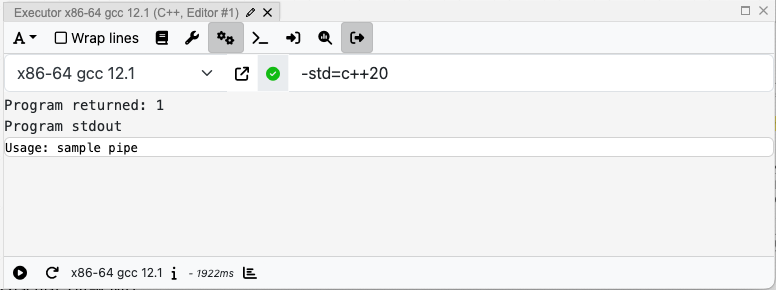
一点点降低版本尝试,发现能编译这段代码的最低 gcc 版本是 11.1,如果你需要在本地安装 gcc 的话,大于等于这个版本就行。
包装一个简单的 Makefile:
all: sample

sample : sample.cpp
	/opt/compiler/gcc-12/bin/g++ -std=c++20 -o $@ $^
	mkfifo communication.pipe

clean:
	rm sample communication.pipe
mkfifo 用于管道文件 (communication.pipe) 的创建。启动 sample 程序后可以在管道另一侧用脚本写一些数据进去:
for ((i=1;i<500;++i)); do echo hello > communication.pipe; done写入 500 个 hello 字符串,接收端的 sample 输出如下:
$ ./sample communication.pipe
Read 6 bytes
Read 60 bytes
Read 6 bytes
Read 54 bytes
Read 6 bytes
Read 6 bytes
Read 6 bytes
Read 6 bytes
Read 6 bytes
Read 6 bytes
Read 6 bytes
Read 6 bytes
Read 12 bytes
Read 0 bytes
Read 6 bytes
Read 6 bytes
Read 6 bytes
Read 6 bytes
Read 6 bytes
Read 6 bytes
...
demo 唯一的参数是 pipe 文件路径。如果使用普通文件做同样的测试:
$ ./sample sample.cpp
terminate called after throwing an instance of 'std::runtime_error'
  what():  epoll_ctl failed, error 1
Aborted (core dumped)
果然报错了,这就是开头所说 epoll 不支持普通文件的特性:对于普通文件,Linux 认为永远可读可写,没必要通过 epoll 进行等待,所以 epoll_ctl 直接返回 EPERM 了。
这个顺便演示了 C++20 编译器会对协程体代码进行 try...catch 的逻辑,任何未捕获的异常终将调用用户承诺对象的 unhandled_exception 接口,这里调了 terminate 来终止进程,关于这一点,请参考《协程本质是函数加状态机》。
代码比较长,下面分段看下:
#include <coroutine>
#include <unordered_map>
#include <sys/epoll.h>
#include <unistd.h>
#include <fcntl.h>
#include <vector>
#include <stdexcept>
#include <iostream>
#include <sstream>

#define MAX_EVENTS 10
返回对象定义,相比之前经典的定义,承诺对象的 final_suspend 未中断协程、返回对象没有析构时销毁协程句柄的动作,意味着协程是个启动后“不管”的类型
struct Task {
    struct promise_type {
        Task get_return_object() { return {}; }
        std::suspend_never initial_suspend() { return {}; }
        std::suspend_never final_suspend() noexcept { return {}; }
        void return_void() {}
        void unhandled_exception() { std::terminate(); }
    };
};
跳到 main,果然没有接收协程体 async_read_file 的返回对象,它返回的临时对象将自动析构,不影响协程体正常运转
int main(int argc, char* argv[]) {
    if (argc < 2) {
        std::cout << "Usage: sample pipe" << std::endl;
        return 1;
    }

    EpollScheduler scheduler;
    async_read_file(scheduler, argv[1]);
    scheduler.run();
return 0;更多推荐
 5
5 0
0- 0


 已为社区贡献4条内容

所有评论(0)