openGauss内核分析(十):数据库索引的创建过程
数据库索引可以提高数据的访问速度, openGauss 支持唯一索引、多字段索引、部分索引和表达式索引。行存表( ASTORE 存储引擎)支持的索引类型: btree (行存表缺省值)、 hash 、 gin 、 gist 。行存表( USTORE 存储引擎)支持的索引类型: ubtree 。列存表支持的索引类型: Psort (列存表缺省值)、 btree 、 gin 。全局临时表不支持 GIN 索引和 Gist 索引。
如上一篇分析 数据库表的创建过程 ,standard_ProcessUtility函数会根据nodeTag(parsetree)的值来确定sql的操作类型,create table一般都是进入T_CreateStmt分支调用CreateCommand函数。create index则进入T_IndexStmt分支调用DefineIndex函数。在调用DefineIndex前会首先执行函数transformIndexStmt,如果语句没有指定索引类型则会使用缺省值。
if (stmt->accessMethod == NULL) {if (!isColStore) {/* row store using btree index by default */if (!RelationIsUstoreFormat(rel)) {stmt->accessMethod = DEFAULT_INDEX_TYPE; // 行存表ASTORE存储引擎缺省值btree} else {stmt->accessMethod = DEFAULT_USTORE_INDEX_TYPE; // 行存表USTORE存储引擎缺省值ubtree}……} else {/* column store using psort index by default */stmt->accessMethod = DEFAULT_CSTORE_INDEX_TYPE; // 列存表缺省值psort}}
D efineInde
DefineIndex为创建索引主入口函数。通常创建索引以Share锁锁定表,允许并发查询,但禁上对表进行修改。如果创建索引时指定关键字CONCURRENTLY以不阻塞DML的方式创建索引,即允许读取和更新表,以ShareUpdateExclusiveLock锁锁定表。
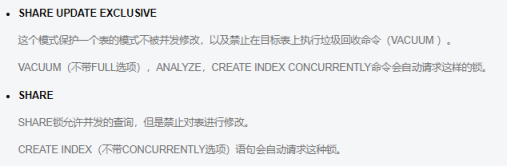
lockmode = concurrent ? ShareUpdateExclusiveLock : ShareLock;rel = heap_open(relationId, lockmode);
如果没有指定索引名,ChooseIndexName根据规则生成索引名:
/** Select name for index if caller didn't specify.*/indexRelationName = stmt->idxname;if (indexRelationName == NULL) {indexRelationName = ChooseIndexName(RelationGetRelationName(rel),namespaceId,indexColNames,stmt->excludeOpNames,stmt->primary,stmt->isconstraint);
为index_create函数构造参数IndexInfo结构体:
Index_create 函数创建索引:/** Prepare arguments for index_create, primarily an IndexInfo structure.* Note that ii_Predicate must be in implicit-AND format.*/indexInfo = makeNode(IndexInfo);
/** Make the catalog entries for the index, including constraints. Then, if* not skip_build || concurrent, actually build the index.*/indexRelationId = index_create(rel,……
关闭表并返回索引表id:
heap_close(rel, NoLock);return indexRelationId;
Index_create 函数
打开系统表pg_class:
pg_class = heap_open(RelationRelationId, RowExclusiveLock);heap_create创建relcache和索引物理文件:
/** create the index relation's relcache entry and physical disk file. (If* we fail further down, it's the smgr's responsibility to remove the disk* file again.)*/StorageType storage_type = RelationGetStorageType(heapRelation);indexRelation = heap_create(indexRelationName, namespaceId, tableSpaceId, indexRelationId, relFileNode,RELATION_CREATE_BUCKET(heapRelation) ? heapRelation->rd_bucketoid : InvalidOid, indexTupDesc, relKind,relpersistence, isLocalPart, false, shared_relation, mapped_relation, allow_system_table_mods,REL_CMPRS_NOT_SUPPORT, (Datum)reloptions, heapRelation->rd_rel->relowner, skip_create_storage,isUstore ? TAM_USTORE : TAM_HEAP, /* XXX: Index tables are by default HEAP Table Type */relindexsplit, storage_type, extra->crossBucket, accessMethodObjectId);
将索引表元信息存入系统表 pg_class:
/** store index's pg_class entry*/InsertPgClassTuple(pg_class, indexRelation, RelationGetRelid(indexRelation), (Datum)0, reloptions, relKind, NULL);/* done with pg_class */heap_close(pg_class, RowExclusiveLock);
将索引表元信息存入系统表pg_index:
UpdateIndexRelation(indexRelationId,heapRelationId,indexInfo,……
Index_build建立索引:
} else if (extra && (!extra->isPartitionedIndex || extra->isGlobalPartitionedIndex)) {/* support regular index or GLOBAL partition index */index_build(heapRelation, NULL, indexRelation, NULL, indexInfo, isprimary, false, PARTITION_TYPE(extra));}
index_build
index_build调用index_build_storage,如果创建的是btree索引最终调用btbuild,如果是hash索引最终调用hashbuild,如果是psort则最终调用psortbuild,更多索引访问方法的信息可查看系统表pg_am。
stats = index_build_storage(targetHeapRelation, targetIndexRelation, indexInfo);static IndexBuildResult* index_build_storage(Relation heapRelation, Relation indexRelation, IndexInfo* indexInfo){RegProcedure procedure = indexRelation->rd_am->ambuild;Assert(RegProcedureIsValid(procedure));IndexBuildResult* stats = (IndexBuildResult*)DatumGetPointer(OidFunctionCall3(procedure, PointerGetDatum(heapRelation), PointerGetDatum(indexRelation), PointerGetDatum(indexInfo)));Assert(PointerIsValid(stats));if (RELPERSISTENCE_UNLOGGED == heapRelation->rd_rel->relpersistence) {index_build_init_fork(heapRelation, indexRelation);}return stats;}
btree索引的procedure为btbuild。
#0 btbuild (fcinfo=0x7fb4f9c63920) at nbtree.cpp:63#1 0x00000000011fc07d in OidFunctionCall3Coll (functionId=338, collation=0, arg1=140415366247440, arg2=140415366237480, arg3=140415402419864) at fmgr.cpp:1857#2 0x0000000000c16b77 in index_build_storage (heapRelation=0x7fb50006b410, indexRelation=0x7fb500068d28, indexInfo=0x7fb5022ea698) at index.cpp:2475#3 0x0000000000c18097 in index_build (heapRelation=0x7fb50006b410, heapPartition=0x0, indexRelation=0x7fb500068d28, indexPartition=0x0, indexInfo=0x7fb5022ea698, isPrimary=false, isreindex=false,partitionType=INDEX_CREATE_NONE_PARTITION, parallel=true) at index.cpp:2834
以上函数调用栈如下:
#0 index_build_storage#1 index_build#2 index_create#3 DefineIndex#4 standard_ProcessUtility#5 gsaudit_ProcessUtility_hook#6 pgaudit_ProcessUtility#7 hypo_utility_hook#8 ProcessUtility#9 PortalRunUtility#10 PortalRun#11 exec_simple_query#12 PostgresMain
分区表索引
创建普通表索引语法如下:
CREATE [ UNIQUE ] INDEX [ CONCURRENTLY ] [ [schema_name.]index_name ]{ ON table_name [ USING method ] | [ USING method ] ON table_name }({ { column_name | ( expression ) } [ COLLATE collation ] [ opclass ] [ ASC | DESC ] [ NULLS { FIRST | LAST } ] }[, ...] )[ index_option ][ WHERE predicate ];
创建分区表索引语法:
两者执行流程基本一致,分区表索引在DefineIndex中是遍历每个分区调用partition_index_create。CREATE [ UNIQUE ] INDEX [ [schema_name.]index_name ]{ ON table_name [ USING method ] | [ USING method ] ON table_name }( {{ column_name | ( expression ) } [ COLLATE collation ] [ opclass ] [ ASC | DESC ] [ NULLS LAST ] }[, ...] )[ LOCAL [ ( { PARTITION index_partition_name [ TABLESPACE index_partition_tablespace ] } [, ...] ) ] | GLOBAL ][ index_option ]
往期推荐
1.openGauss内核分析(一):多线程架构启动过程详解
本文分享自微信公众号 - openGauss(openGauss)。
如有侵权,请联系 support@oschina.cn 删除。
本文参与“ OSC源创计划 ”,欢迎正在阅读的你也加入,一起分享。

华为技术汇总页
更多推荐


 0
0 0
0- 0


 已为社区贡献10条内容

所有评论(0)