
大数据相关学习-4.Spark
1.spark 是什么?
spark 是一个开源的分布式计算引擎,专为大规模数据处理而设计。它提供了高级API,支持Java、Scala、Python 和R语言,能高效地执行批处理、流处理、图处理等多种工作负载。
spark 是apache 大数据生态的重要组成部分,主要用于替代hadoop 中的MapReduce 计算模型,在典型的大数据平台中,常见架构为:
HDFS(存储) + YARN(调度与资源管理) + Spark(计算引擎)
既然spark 主要是代替mapreduce,那就来看看两者的区别
| 维度 | MapReduce | Spark |
|---|---|---|
| 计算模型 | 仅支持 Map 和 Reduce 两个阶段 | 支持丰富的Transformation 和Action 操作(如 map、filter、join、reduceByKey 等API) |
| 数据存储位置 | 中间结果必须写入磁盘 | 中间结果默认保留在内存中(可持久化到磁盘) |
| 执行引擎 | 基于“Map → Shuffle → Reduce”的线性流程 | 基于DAG 的执行引擎,可优化任务调度 |
| 处理速度 | 较慢(频繁 I/O) | 更快 |
| 容错机制 | 通过重跑失败任务实现 | 基于 RDD 的 血统(Lineage) 重建丢失数据 |
| 实时处理 | 不支持 | 支持(通过 Spark Streaming / Structured Streaming) |
| 编程复杂度 | 较高(需编写 Mapper/Reducer 类) | 更简洁(函数式编程风格) |
| 适用场景 | 简单批处理、资源受限环境 | 复杂 ETL、流处理、图计算、机器学习、交互分析等 |
下面是同一个wordcount 程序分别用mapreduce 和spark 作执行引擎时需要编写的java 代码,都省略了import 语句。可以看到mapreduce 程序必须要编写mapper 和 reducer 类,并且只能处理简单批式任务,对于复杂任务是束手无策的。
mapreduce:
public class WordCountDriver {
    public static void main(String[] args) throws Exception {
        if (args.length != 2) {
            System.err.println("用法: WordCountDriver <输入路径> <输出路径>");
            System.exit(-1);
        }
        Configuration conf = new Configuration();
        Job job = Job.getInstance(conf, "Word Count");
        job.setJarByClass(WordCountDriver.class);
        job.setMapperClass(WordCountMapper.class);
        job.setReducerClass(WordCountReducer.class);
        job.setOutputKeyClass(Text.class);
        job.setOutputValueClass(IntWritable.class);
        FileInputFormat.addInputPath(job, new Path(args[0]));
        FileOutputFormat.setOutputPath(job, new Path(args[1]));
        System.exit(job.waitForCompletion(true) ? 0 : 1);
    }
}
public class WordCountMapper extends Mapper<LongWritable, Text, Text, IntWritable> {
    private final static IntWritable one = new IntWritable(1);
    private Text word = new Text();

    @Override
    public void map(LongWritable key, Text value, Context context) throws IOException, InterruptedException {
        String line = value.toString();
        StringTokenizer tokenizer = new StringTokenizer(line);
        while (tokenizer.hasMoreTokens()) {
            word.set(tokenizer.nextToken().toLowerCase());
            context.write(word, one);
        }
    }
}
public class WordCountReducer extends Reducer<Text, IntWritable, Text, IntWritable> {
    private IntWritable result = new IntWritable();

    @Override
    public void reduce(Text key, Iterable<IntWritable> values, Context context)
            throws IOException, InterruptedException {

        int sum = 0;
        for (IntWritable val : values) {
            sum += val.get();
        }
        result.set(sum);
        context.write(key, result);
    }
}
spark:
public class SparkWordCount {
    public static void main(String[] args) {
        if (args.length != 2) {
            System.err.println("用法: WordCountDriver <输入路径> <输出路径>");
            System.exit(-1);
        }
        SparkConf conf = new SparkConf().setAppName("Word Count");
        JavaSparkContext sc = new JavaSparkContext(conf);
        JavaRDD<String> textFile = sc.textFile(args[0]);
        JavaRDD<String> words = textFile.flatMap(line ->
                Arrays.asList(line.toLowerCase().split("\\s+")).iterator()
        ).filter(word -> !word.isEmpty());
        JavaPairRDD<String, Integer> wordPairs = words.mapToPair(word ->
                new Tuple2<>(word, 1)
        );
        JavaPairRDD<String, Integer> wordCounts = wordPairs.reduceByKey(
                (count1, count2) -> count1 + count2
        );
        wordCounts.saveAsTextFile(args[1]);
        sc.close();
    }
}
2. Spark 架构简介
spark 的主要架构包含三个部分:
- Driver:运行 main() 函数,构建 DAG,调度任务。
- Executor:在工作节点上执行具体任务,缓存数据。
- Cluster Manager:可以是 Standalone、YARN、Kubernetes 等。
Spark 架构图以及一个spark 任务执行的大致过程:
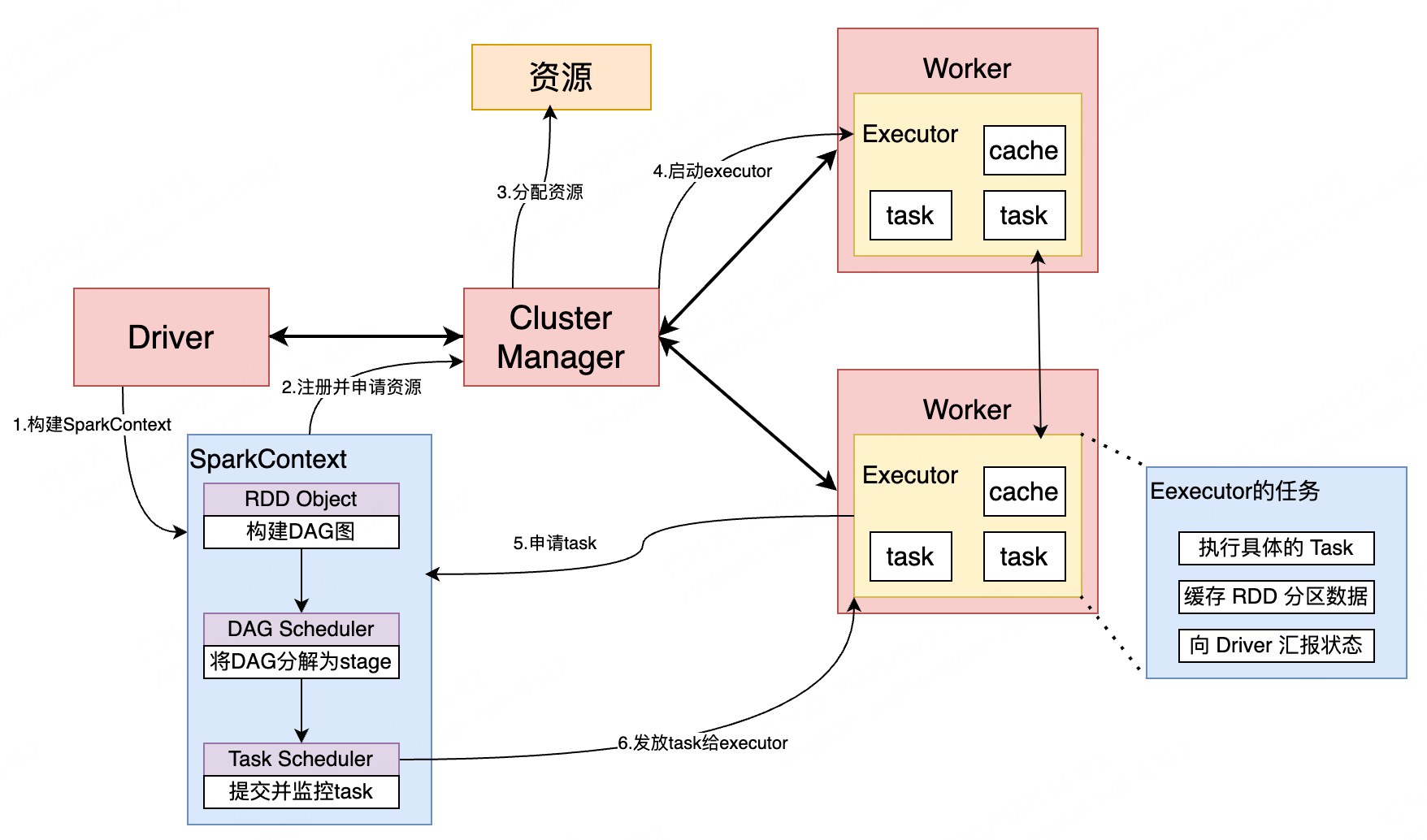
3.Spark 运行流程总览
- 用户编写 Spark 应用程序
- 启动 Driver 进程,创建 SparkContext
- SparkContext 向集群管理器(Cluster Manager)申请资源
- 集群启动 Executor 进程
- 任务(Task)分发给 Executor 执行
- Executor 执行计算并返回结果(或写入外部存储)
- 应用结束,释放资源,Driver 退出,SparkContext 关闭,Executor释放
Spark 采用惰性求值(Lazy Evaluation) 机制:
- Transformation 操作(如
map,filter,join)只记录血统(Lineage),不立即执行。 - Action 操作(如
collect(),count(),saveAsTextFile())才会真正触发计算。
当 Action 被调用时:
- DAGScheduler 将 RDD 依赖关系划分为多个 Stage(以 Shuffle 为边界)。
- 每个 Stage 包含多个 Task(每个分区对应一个 Task)。
- TaskScheduler 将 Task 分发给可用的 Executor。
4.stage 划分机制
Stage 是 Spark 中一组可以并行执行且无需 Shuffle 的 Task 集合。
Spark 的 DAGScheduler 会根据 RDD 之间的依赖关系,将整个计算流程划分为多个 Stage,每个 Stage 内部只包含 窄依赖(Narrow Dependency) 操作。
stage 划分的核心依据:RDD 依赖类型
Spark 根据 RDD 之间的依赖关系 来决定是否切分 Stage:
窄依赖(不切分):父 RDD 的一个分区最多被一个子 RDD 分区使用,即一对一或者多对一的关系(如 map, filter, union)
宽依赖(切分):父 RDD 的一个分区会被子 RDD 的多个分区依赖(涉及到 shuffle)。即一对多的关系(如 groupByKey, reduceByKey, join, distinct)
public static void main(String[] args) {
        // Initialize Spark configuration and context
        SparkConf conf = new SparkConf().setAppName("RDD Word Count Example");
        JavaSparkContext sc = new JavaSparkContext(conf);

        // rdd = sc.textFile("hdfs://data.txt") - 4 partitions
        JavaRDD<String> rdd = sc.textFile("hdfs://data.txt", 4);

        // words = rdd.flatMap(lambda x: x.split()) - narrow transformation
        JavaRDD<String> words = rdd.flatMap(line ->
            java.util.Arrays.asList(line.split("\\s+")).iterator()
        );

        // pairs = words.map(lambda w: (w, 1)) - narrow transformation
        JavaPairRDD<String, Integer> pairs = words.mapToPair(word ->
            new Tuple2<>(word, 1)
        );

        // counts = pairs.reduceByKey(lambda a, b: a + b) - wide transformation (shuffle!)
        JavaPairRDD<String, Integer> counts = pairs.reduceByKey((a, b) -> a + b);

        // output = counts.filter(lambda x: x[1] > 10) - narrow transformation
        JavaPairRDD<String, Integer> output = counts.filter(tuple -> tuple._2() > 10);

        // output.saveAsTextFile("result") - action
        output.saveAsTextFile("result");

        // Close the Spark context
        sc.close();
    }
构建DAG:textFile → flatMap → map → reduceByKey → filter
反向遍历:DAGScheduler 从最终的 Action(saveAsTextFile)开始,反向扫描依赖链,直到遇到 reduceByKey 宽依赖:
filter和saveAsTextFile属于 ResultStagetextFile→flatMap→map属于 ShuffleMapStage
最终划分结果:
- Stage 0(ShuffleMapStage):
textFile → flatMap → map。输出中间结果(<word, 1>)到磁盘/内存,供 Shuffle 使用 - Stage 1(ResultStage):
reduceByKey → filter → saveAsTextFile。从 Shuffle 读取数据,聚合后过滤并写入文件
更多推荐
 13
13 0
0- 0


 已为社区贡献6条内容

所有评论(0)