
Python 豆包AI实战:通过 文字 + 图片 一键生成短视频
·
介绍
下面介绍火山方舟豆包AI通过文字+图片一键生成短视频并保存到本地的完整python代码,生成短视频的逻辑是,先提交再等待生成完成再下载
准备
- 安装python3.14
- 夸克网盘:https://pan.quark.cn/s/b88e55905e7b
- 百度网盘:https://pan.baidu.com/s/1d22gCHP_qWq5_L_Ik-tvNg?pwd=f8ah
- 火山引擎注册账号,地址:https://console.volcengine.com/home
- 火山方舟创建API Key,https://console.volcengine.com/ark/region:ark+cn-beijing/apiKey
- 火山方舟开通模型:https://console.volcengine.com/ark/region:ark+cn-beijing/openManagement
开始
- 安装依赖包
- 火山方舟:pip install ‘volcengine-python-sdk[ark]’
- OpenAI:pip install openai
- 其他:pip install requests
- 项目配置,config.py 配置文件,未配置或配置错误无法运行
- api_key,刚创建的火山方舟 API Key
- 项目执行,main.py 主文件
- python main.py
代码
- 配置,config.py
# 火山方舟 API Key
api_key = ""

# 模型ID
model_id = "doubao-seedance-2-0-fast-260128"
- 模型调用,model.py
from datetime import datetime

import config as config
import uuid
import os
import requests
import time

base_url = "https://ark.cn-beijing.volces.com/api/v3"


def execute(text: str, image: str):
    try:
        response = requests.post(
            url=f"{base_url}/contents/generations/tasks",
            headers={"Authorization": f"Bearer {config.api_key}", "Content-Type": "application/json"},
            json={
                "model": config.model_id,
                "content": [{"type": "text", "text": text}, {"type": "image_url", "image_url": {"url": image}, "role": "reference_image"}],
                "resolution": "480p",
                "duration": 5,
                "watermark": False,
            },
        )

        print(response.json())

        video_id = response.json()["id"]
        if is_empty(video_id):
            return ""

        second = 1
        while True:
            print(f"正在查询视频生成状态,视频编号:{video_id},{second}秒")
            # 休眠1秒再去查
            time.sleep(1)
            second = second + 1

            video_response = get_video(video_id)
            if is_empty(video_response):
                return ""

            # 状态判断
            video_status = video_response["status"]
            if video_status == "queued" or video_status == "running":
                continue
            elif video_status == "succeeded":
                return video_response["content"]["video_url"]
            else:
                return ""

    except Exception as e:
        print(f"调用接口失败,失败原因:{str(e)}")
        return ""


def get_video(video_id: str) -> dict:
    try:
        response = requests.get(
            url=f"{base_url}/contents/generations/tasks/{video_id}",
            headers={"Authorization": f"Bearer {config.api_key}", "Content-Type": "application/json"},
        )
        return response.json()
    except Exception as e:
        print(f"调用接口失败,失败原因:{str(e)}")
        return {}


def save(video_url: str):
    try:
        # 发送请求,设置超时时间
        response = requests.get(video_url, timeout=10)
        # 请求失败直接抛异常
        response.raise_for_status()

        image_directory = os.path.join("result", datetime.now().strftime("%Y%m%d%H%M%S"))
        os.makedirs(image_directory, exist_ok=True)

        image_name = str(uuid.uuid4()).replace("-", "") + ".mp4"
        image_path = os.path.join(image_directory, image_name)

        # 写入文件(二进制模式)
        with open(image_path, "wb") as f:
            f.write(response.content)

        return image_path
    except Exception as e:
        print(f"图片视频下载失败,失败原因:{str(e)}")
        return ""


def is_empty(obj) -> bool:
    """
    判断对象是否为空(最常用)
    :return: 空 = True,非空 = False
    """
    # 为 None
    if obj is None:
        return True

    # 字符串(含全空格、空串)
    if isinstance(obj, str):
        return obj.strip() == ""

    # 列表、字典、元组、集合(长度 0)
    if isinstance(obj, (list, dict, tuple, set)):
        return len(obj) == 0

    # 其他类型(0、False 不算空)
    return False
- 主方法,main.py
import config as config
import model as model
import util.image_util as image_util
import sys

if config.api_key == "":
    print(f"火山方舟大模型 API Key 未配置")
    sys.exit()

print("=====我能生成任何你想要的短视频,说出你想要什么吧=====\n")

prompt = ""

while True:
    prompt = input("需求:").strip()

    if prompt == "":
        print("什么也没说,说点什么吧")
        continue

    break

print("系统:选择一张图片吧")

image_base64 = image_util.img_to_base64()
if image_base64 is None or image_base64 == "":
    print("没有选择任何图片哦")
    sys.exit()

print("AI正在按照你的需求生成,请稍候...")

video_url = model.execute(prompt, image_base64)
if video_url is None or video_url == "":
    print("视频生成失败,请重试")
    sys.exit()

video_path = model.save(video_url)
if video_path is None or video_path == "":
    print("视频生成失败,请重试")
    sys.exit()

print(f"视频生成成功,视频路径:{video_path}")
- 图片选择工具,image_util.py
import tkinter
from tkinter import filedialog
import base64

def img_to_base64():
    # 初始化并隐藏主窗口
    root = tkinter.Tk()
    root.withdraw()
    root.attributes("-topmost", True)

    # 选择图片文件
    file_path = filedialog.askopenfilename(
        title="选择图片",
        filetypes=[
            ("图片", "*.png;*.jpg;*.jpeg;*.gif;*.bmp"),
            ("全部文件", "*.*")
        ]
    )
    if not file_path:
        print("未选择文件")
        return ""

    # 二进制读取 + 转 base64
    with open(file_path, "rb") as f:
        img_bytes = f.read()

    # base64
    b64_str = base64.b64encode(img_bytes).decode("utf-8")

    # 文件格式
    fmt = get_image_format(file_path)

    return f"data:image/{fmt};base64,{b64_str}"

def get_image_format(file_path):
    with open(file_path, "rb") as f:
        head = f.read(12)

    if head[:3] == b"\xff\xd8\xff":
        return "jpeg"
    elif head[:8] == b"\x89PNG\r\n\x1a\n":
        return "png"
    elif head[:6] in (b"GIF87a", b"GIF89a"):
        return "gif"
    elif head[:2] == b"BM":
        return "bmp"
    elif head[:4] == b"RIFF" and head[8:12] == b"WEBP":
        return "webp"
    else:
        return "jpeg"
成功展示
![[图片]
[图片]](https://i-blog.csdnimg.cn/direct/aa683ffda85549ffbae366a09e6571cb.png)
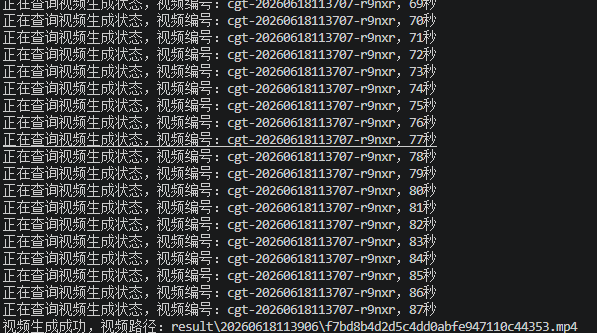
- 生成成功的视频地址,点击查看
注意
- 火山引擎注册会送很多免费的token,刚开始测试都是不需要费用的
- 完整的代码下载:https://download.csdn.net/download/lazy_uu/93022433
更多推荐
 9
9 0
0- 0


 已为社区贡献5条内容

所有评论(0)