
JavaSE大神进阶篇(第九期):反射机制体现动态编程的强大利器
·
通过案例体会反射的好处
-
案例:美团外卖 —> 付款 —> 要么用微信支付 要么用支付宝支付
-
代码展示:
package com.xxx.test01;

//接口的制定方:美团外卖
public interface Mtwm {
    //在线支付功能:
    void payOnline();
}
public class WeChat implements Mtwm { @Override public void payOnline() { //具体实现微信支付的功能: System.out.println("我已经点了外卖,正在使用微信支付"); } }public class AliPay implements Mtwm { @Override public void payOnline() { //具体的支付宝支付: System.out.println("我已经点了外卖,我正在使用支付宝进行支付"); } }public class BankCard implements Mtwm { @Override public void payOnline() { System.out.println("我已经定了外卖,我正在用招商银行信用卡支付"); } } -
测试类:
package com.zhaoss.test01; public class Test { public static void main(String[] args) { //定义一个字符串,用来模拟前台的支付方式: String str = "微信"; if("微信".equals(str)) { //str.equals("微信") ---?避免空指针异常 //微信支付: //new WeChat().payOnline(); pay(new WeChat()); } if("支付宝".equals(str)) { //支付宝支付: //new AliPay().payOnline(); pay(new AliPay()); } if("招商银行".equals(str)){ pay(new BankCard()); } } //微信支付 public static void pay(WeChat wc) { wc.payOnline(); } //支付宝支付 public static void pay(AliPay ap) { ap.payOnline(); } //招商银行支付 public static void pay(BankCard bc){ bc.payOnline(); } } -
为了提高代码的扩展性 —> 面向对象特性:多态:
package com.zhaoss.test01; public class Test { public static void main(String[] args) { //定义一个字符串,用来模拟前台的支付方式: String str = "微信"; if("微信".equals(str)) { //str.equals("微信")---?避免空指针异常 //微信支付: pay(new WeChat()); } if("支付宝".equals(str)) { //支付宝支付: pay(new AliPay()); } if("招商银行".equals(str)) { pay(new BankCard()); } } //方法形参是接口,具体传入的是接口的实现类的对象 ---> 多态的一种形式 public static void pay(Mtwm m) { m.payOnline(); } } //多态确实可以提高代码的扩展性,但是:扩展性没有达到最好 //怎么没有达到最好:上面的分支,还是需要手动的删除或者添加 //解决办法:反射机制 -
利用反射实现上述功能:
package com.zhaoss.test01;

import java.lang.reflect.InvocationTargetException;
import java.lang.reflect.Method;

public class Demo {
    public static void main(String[] args) throws Exception {
        //定义一个字符串,用来模拟前台的支付方式:
        String str = "com.zhaoss.test01.AliPay";  //字符串:实际上 --> 就是微信类的全限定路径

        //下面的代码就是利用反射:
        Class cls = Class.forName(str); //cls --> Class类具体的对象 --> AliPay字节码信息
        Object o = cls.newInstance();
        Method method = cls.getMethod("payOnline");
        method.invoke(o);
    }
}
-
通过概念再体会反射
Class类的理解
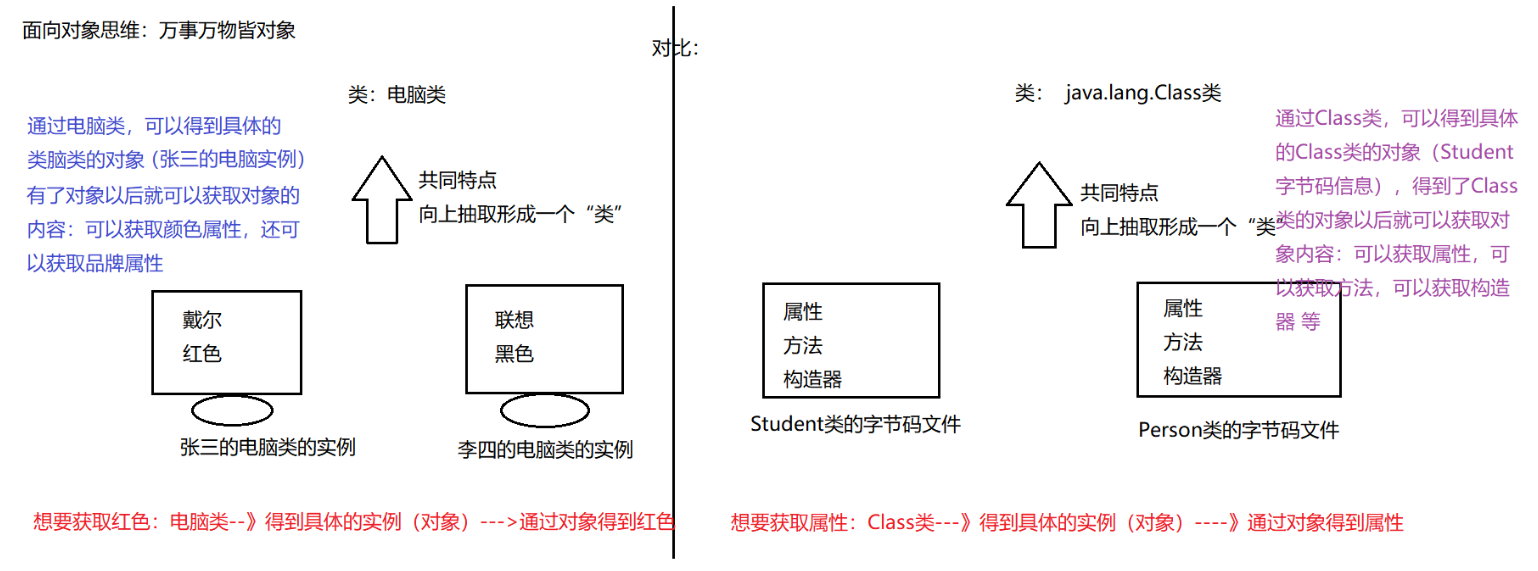
提供丰富的类
-
代码展示
package com.zhaoss.test02;

//作为一个父类
public class Person {
    //属性
    private int age;
    public String name;

    //方法
    private void eat(){
        System.out.println("Person---eat");
    }

    public void sleep(){
        System.out.println("Person---sleep");
    }
}
package com.zhaoss.test02; //Student作为子类 public class Student extends Person { //属性: private int sno; //学号 double height; //身高 protected double weight; //体重 public double score; //成绩 //方法: public String showInfo() { return "我是一名三好学生"; } private void work(){ System.out.println("我以后会找工作 --> 成为码农 程序员 程序猿 程序媛"); } //构造器 public Student(){ System.out.println("空参构造器"); } private Student(int sno) { this.sno = sno; } Student(int sno, double weight) { this.sno = sno; this.weight = weight; } }
获取字节码信息的四种形式
-
代码展示
package com.zhaoss.test02;

public class Test {
    public static void main(String[] args) throws ClassNotFoundException {
        //案例:以Person的字节码信息为案例
        //方式1:通过getClass()方法获取
        Person p = new Person();
        Class c1 = p.getClass();
        System.out.println(c1);

        //方式2:通过内置class属性:
        Class c2 = Person.class;
        System.out.println(c2);
        System.out.println(c1 == c2);

        //注意:方式1和方式2  不常用
        //方式3:用的最多:调用Class类提供的静态方法forName
        Class c3 = Class.forName("com.zhaoss.test02.Person");

        //方式4:利用类的加载器(了解技能点)
        ClassLoader loader = Test.class.getClassLoader();
        Class c4 = loader.loadClass("com.zhaoss.test02.Person");
    }
}
可以作为Class类的实例的种类
-
Class类的具体的实例:
-
验证:
package com.zhaoss.test02;

public class Demo {
    public static void main(String[] args) {
        /*
        Class类的具体的实例:
        (1)类:外部类,内部类
        (2)接口
        (3)注解
        (4)数组
        (5)基本数据类型
        (6)void
        */
       Class c1 = Person.class;
       Class c2 = Comparable.class;
       Class c3 = Override.class;

       int[] arr1 = {1,2,3};
       Class c4 = arr1.getClass();
       int[] arr2 = {5,6,7};
       Class c5 = arr2.getClass();
       System.out.println(c4 == c5); //结果:true .同一个维度,同一个元素类型,得到的字节码就是同一个

       Class c6 = int.class;
       Class c7 = void.class;
    }
}
获取运行时类的完整结构
-
补充完善上面提供的丰富的类
-
代码
//作为一个父类
public class Person implements Serializable {
    //属性
    private int age;
    public String name;

    //方法
    private void eat(){
        System.out.println("Person---eat");
    }

    public void sleep(){
        System.out.println("Person---sleep");
    }
}
package com.zhaoss.test03; //Student作为子类 @MyAnnotation(value="hello") public class Student extends Person implements MyInterface{ //属性: private int sno; //学号 double height; //身高 protected double weight; //体重 public double score; //成绩 //方法: @MyAnnotation(value="himethod") public String showInfo(){ return "我是一名三好学生"; } public String showInfo(int a, int b){ return "重载方法 ==== 我是一名三好学生"; } private void work(){ System.out.println("我以后会找工作 --> 成为码农 程序员 程序猿 程序媛"); } void happy(){ System.out.println("做人最重要的就是开心每一天"); } protected int getSno(){ return sno; } //构造器 public Student(){ System.out.println("空参构造器"); } private Student(int sno){ this.sno = sno; } Student(int sno, double weight){ this.sno = sno; this.weight = weight; } protected Student(int sno, double height, double weight){ this.sno = sno; } @Override @MyAnnotation(value="hellomyMethod") public void myMethod() { System.out.println("我重写了myMethod方法。。"); } @Override public String toString() { public String toString() { "sno=" + sno + ", height=" + height + ", weight=" + weight + ", score=" + score + '}'; } } }package com.zhaoss.test03; import java.lang.annotation.Retention; import java.lang.annotation.RetentionPolicy; import java.lang.annotation.Target; import static java.lang.annotation.ElementType.*; import static java.lang.annotation.ElementType.LOCAL_VARIABLE; /* @Target:定义当前注解能够修饰程序中的哪些元素 @Retention:定义注解的声明周期 */ @Target({TYPE, FIELD, METHOD, PARAMETER, CONSTRUCTOR, LOCAL_VARIABLE}) @Retention(RetentionPolicy.RUNTIME) public @interface MyAnnotation { String value(); //属性 }package com.zhaoss.test03; public interface MyInterface { //自定义的接口 //随便定义一个抽象方法: void myMethod(); }
-
-
获取构造器和创建对象
-
代码展示
package com.zhaoss.test03;

import java.lang.reflect.Constructor;
import java.lang.reflect.InvocationTargetException;

public class Test01 {
    public static void main(String[] args) throws NoSuchMethodException, IllegalAccessException, InvocationTargetException, InstantiationException {
        //获取字节码信息:
        Class cls = Student.class;

        //通过字节码信息可以获取构造器:
        //getConstructors只能获取当前运行时类的被public修饰的构造器
        Constructor[] c1 = cls.getConstructors();
        for(Constructor c:c1){
            System.out.println(c);
        }

        System.out.println("-------------------");
        //getDeclaredConstructors: 获取运行时类的全部修饰符的构造器
        Constructor[] c2 = cls.getDeclaredConstructors();
        for(Constructor c:c2){
            System.out.println(c);
        }

        System.out.println("-------------------");
        //获取指定的构造器:
        //得到空构造器
        Constructor con1 = cls.getConstructor();
        System.out.println(con1);

        //得到两个参数的有参构造器:
        Constructor con2 = cls.getConstructor(double.class, double.class);
        System.out.println(con2);

        //得到一个参数的有参构造器:并且是private修饰的
        Constructor con3 = cls.getDeclaredConstructor(int.class);
        System.out.println(con3);

        //有了构造器以后我就可以创建对象:
        Object o1 = con1.newInstance();
        System.out.println(o1);

        Object o2 = con2.newInstance(180.5, 170.6);
        System.out.println(o2);
    }
}
-
-
获取属性和对属性进行赋值
-
代码展示
package com.zhaoss.test03;

import java.lang.reflect.Field;
import java.lang.reflect.Modifier;

public class Test02 {
    public static void main(String[] args) throws NoSuchFieldException, IllegalAccessException, InstantiationException {
        //获取运行时类的字节码信息:
        Class cls = Student.class;
        //获取属性:
        //getFields:获取运行时类和父类中被public修饰的属性
        Field[] fields = cls.getFields();
        for(Field f:fields){
            System.out.println(f);
        }
        System.out.println("---------------------");

        //getDeclaredFields:获取运行时类中的所有属性
        Field[] declaredFields = cls.getDeclaredFields();
        for(Field f:declaredFields){
            System.out.println(f);
        }
        System.out.println("---------------------");

        //获取指定的属性:
        Field score = cls.getField("score");
        System.out.println(score);
        Field sno = cls.getDeclaredField("sno");
        System.out.println(sno);
        System.out.println("---------------------");

        //属性的具体结构:
        //获取修饰符
        /*
        int modifiers = sno.getModifiers();
        System.out.println(modifiers);
        System.out.println(Modifier.toString(modifiers));
        */
        System.out.println(Modifier.toString(sno.getModifiers()));
        //获取属性的数据类型:
        Class clazz = sno.getType();
        System.out.println(clazz.getName());

        //获取属性的名字:
        String name = sno.getName();
        System.out.println(name);
        System.out.println("-------------------------------");

        //给属性赋值:(给属性设置值,必须要有对象)
        Field sco = cls.getField("score");
        Object obj = cls.newInstance();
        sco.set(obj,98); //给obj这个对象的score属性设置具体的值,这个值为98
        System.out.println(obj);
    }
}
-
-
获取方法和调用方法
-
代码展示
package com.zhaoss.test03;

import java.lang.annotation.Annotation;
import java.lang.reflect.InvocationTargetException;
import java.lang.reflect.Method;
import java.lang.reflect.Modifier;

public class Test03 {
    public static void main(String[] args) throws NoSuchMethodException, IllegalAccessException, InstantiationException, InvocationTargetException {
        //获取字节码信息:
        Class cls = Student.class;
        //获取方法:
        //getMethods: 获取运行时类的方法还有所有父类中的方法(被public修饰)
        Method[] methods = cls.getMethods();
        for(Method m: methods){
            System.out.println(m);
        }
        System.out.println("-----------------------");
        //getDeclaredMethods: 获取运行时类中的所有方法:
        Method[] declaredMethods = cls.getDeclaredMethods();
        for(Method m: declaredMethods){
            System.out.println(m);
        }
        System.out.println("-----------------------");
        //获取指定的方法:
        Method showInfo1 = cls.getMethod("showInfo");
        System.out.println(showInfo1);
        Method showInfo2 = cls.getMethod("showInfo", int.class, int.class);
        System.out.println(showInfo2);
        Method work = cls.getDeclaredMethod("work", int.class);
        System.out.println(work);
        System.out.println("-----------------------");
        //获取方法的具体结构:
        /*
        @注解
        修饰符 返回值类型  方法名(参数列表) throws XXXXX{}
        */
        //名字:
        System.out.println(work.getName());
        //修饰符:
        int modifiers = work.getModifiers();
        System.out.println(Modifier.toString(modifiers));
        //返回值:
        System.out.println(work.getReturnType());
        //参数列表:
        Class[] parameterTypes = work.getParameterTypes();
        for(Class c: parameterTypes){
            System.out.println(c);
        }

        //获取注解:
        Method myMethod = cls.getMethod("myMethod");
        Annotation[] annotations = myMethod.getAnnotations();
        for(Annotation a: annotations){
            System.out.println(a);
        }

        //获取异常:
        Class[] exceptionTypes = myMethod.getExceptionTypes();
        for(Class c: exceptionTypes){
            System.out.println(c);
        }

        //调用方法:
        Object o = cls.newInstance();
        myMethod.invoke(o); //调用o对象的mymethod方法

        System.out.println(showInfo2.invoke(o,12,45));;
    }
}
-
-
获取类的接口,所在包,注解
-
代码展示
package com.zhaoss.test03;

import java.lang.annotation.Annotation;

public class Test04 {
    public static void main(String[] args) {
        //获取字节码信息:
        Class cls = Student.class;
        //获取运行时类的接口:
        Class[] interfaces = cls.getInterfaces();
        for(Class c: interfaces){
            System.out.println(c);
        }

        //得到父类的接口:
        //先得到父类的字节码信息:
        Class superclass = cls.getSuperclass();

        //得到接口:
        Class[] interfaces1 = superclass.getInterfaces();
        for(Class c: interfaces1){
            System.out.println(c);
        }

        //获取运行时类所在的包:
        Package aPackage = cls.getPackage();
        System.out.println(aPackage);
        System.out.println(aPackage.getName());
        //获取运行类的注解:
        Annotation[] annotations = cls.getAnnotations();
        for(Annotation a: annotations){
            System.out.println(a);
        }
    }
}
-
-
关于反射的面试题
更多推荐
 4
4 0
0- 0


 已为社区贡献9条内容

所有评论(0)